US National Debt 2026: Impact on Your Finances and Future

In the vast landscape of economic indicators, few figures loom as large and as potentially impactful as the US National Debt. As we look towards 2026, projections indicate this colossal sum is set to reach an staggering $34 trillion. This isn’t just an abstract number; it’s a financial behemoth with profound implications for every American, from the stability of the dollar to the cost of your daily expenses and the security of your retirement. Understanding the US National Debt is crucial for navigating your personal financial future. This comprehensive article will delve into the intricacies of this burgeoning debt, exploring its causes, its potential economic ramifications, and, most importantly, how it could directly affect your personal finances.
Understanding the $34 Trillion US National Debt by 2026: A Deep Dive into Its Impact on Your Personal Finances
The concept of national debt can often feel distant, a matter for economists and politicians rather than the everyday citizen. However, the reality is far different. The trajectory of the US National Debt is a critical determinant of the economic environment in which we all live, work, and plan for our futures. With projections soaring to $34 trillion by 2026, the urgency to understand this phenomenon has never been greater. This article aims to demystify the national debt, breaking down its complexities into understandable terms and illustrating its tangible effects on your wallet, your investments, and your overall financial well-being.
What Exactly is the US National Debt?
Before we can fully appreciate the implications of a $34 trillion US National Debt, it’s essential to define what it actually is. In simple terms, the national debt, also known as public debt, is the total amount of money that the United States federal government owes to its creditors. These creditors can be domestic or foreign, including individual investors, corporations, foreign governments, and even other government agencies.
Components of the National Debt:
- Public Debt: This is the portion of the national debt held by the public, including individuals, corporations, state and local governments, Federal Reserve Banks, and foreign governments. When you buy a U.S. Treasury bond, you are essentially lending money to the government, and that amount becomes part of the public debt.
- Intragovernmental Holdings: This portion represents government account balances, primarily federal trust funds like Social Security and Medicare. These funds often invest their surpluses in special Treasury securities, which are essentially debts the government owes to itself.
Both components contribute to the total US National Debt. The $34 trillion projection for 2026 encompasses both of these elements, highlighting the sheer scale of the government’s financial obligations.
The Road to $34 Trillion: Key Drivers of the US National Debt
Understanding how the US National Debt reached its current and projected levels requires examining the various factors that contribute to government spending and revenue. It’s a complex interplay of economic cycles, policy decisions, and unforeseen events.
Historical Context and Recent Trends:
The US National Debt has been on a generally upward trend for decades, but certain periods have seen more rapid accumulation. Major wars, economic recessions, and significant policy changes have historically led to spikes in borrowing. More recently, several key drivers have accelerated the growth of the debt:
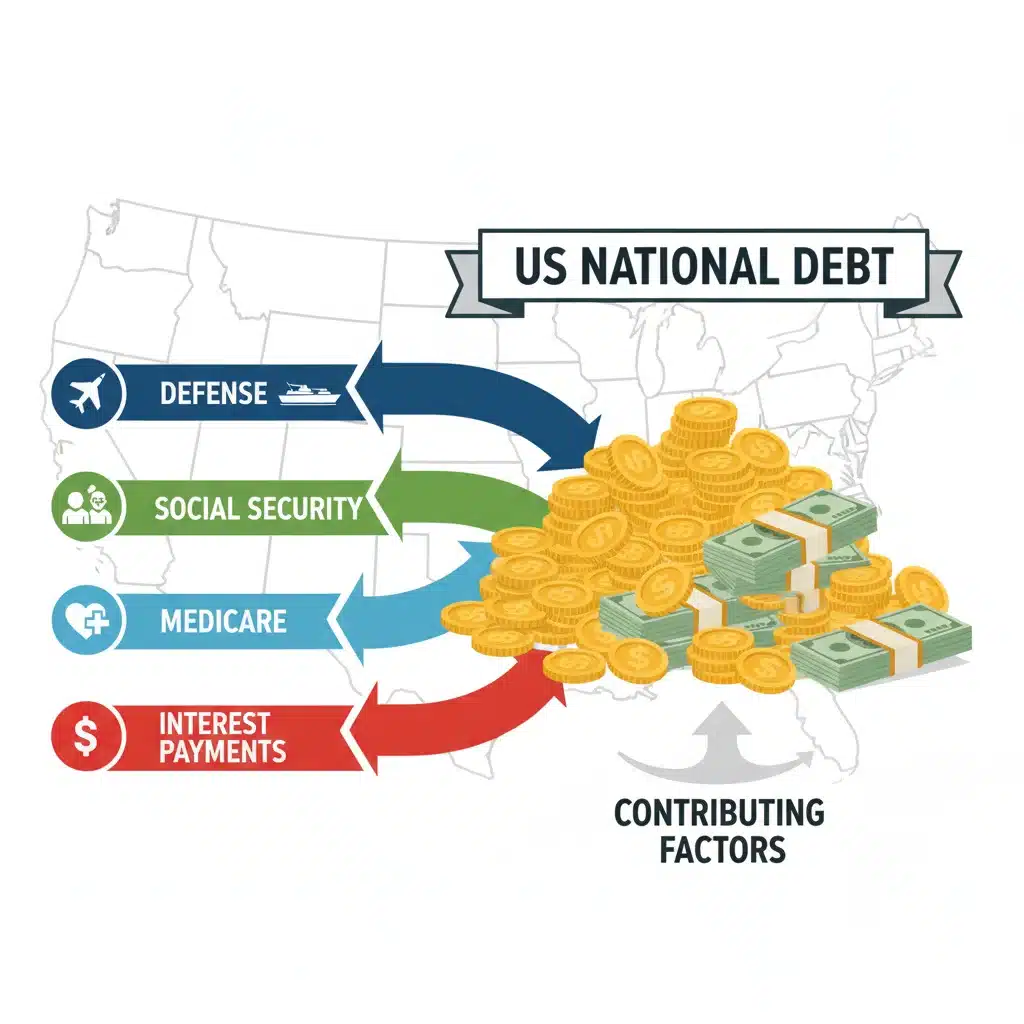
- Increased Government Spending: This is arguably the most direct cause. Government expenditures on programs like Social Security, Medicare, Medicaid, defense, and infrastructure projects consistently outpace revenue. Significant spending increases during crises, such as the 2008 financial crisis and the COVID-19 pandemic, have added trillions to the debt. Stimulus packages, unemployment benefits, and business support programs were essential during these times but came at a substantial cost.
- Tax Cuts: Reductions in tax rates, while intended to stimulate economic growth, can also lead to decreased government revenue, especially if not offset by spending cuts or corresponding economic expansion. The Tax Cuts and Jobs Act of 2017, for example, significantly reduced corporate and individual income tax rates, contributing to a widening budget deficit.
- Aging Population and Entitlement Programs: The demographic shift towards an older population means a larger proportion of the population is drawing benefits from Social Security and Medicare. These entitlement programs are major drivers of long-term spending growth, as the number of beneficiaries increases and healthcare costs continue to rise.
- Interest Payments on the Debt: As the national debt grows, so do the interest payments required to service that debt. When interest rates rise, these payments can become a significant portion of the federal budget, diverting funds that could otherwise be used for other programs or debt reduction. This creates a feedback loop: higher debt leads to higher interest payments, which in turn can lead to more borrowing.
- Economic Recessions: During economic downturns, government revenue from taxes typically falls as unemployment rises and corporate profits decline. Simultaneously, government spending on unemployment benefits, food assistance, and other social safety nets tends to increase, further exacerbating budget deficits and contributing to the US National Debt.
Macroeconomic Consequences of a $34 Trillion US National Debt
The sheer scale of a $34 trillion US National Debt has far-reaching macroeconomic consequences that can ripple through the entire global economy. These effects are not always immediately apparent but can have profound long-term impacts on growth, stability, and international relations.
Potential Economic Ramifications:
- Higher Interest Rates: A large and growing national debt can lead to higher interest rates. When the government needs to borrow more, it increases the demand for credit, which can push up interest rates across the board. This means higher borrowing costs for businesses, making it more expensive to invest and expand, and for consumers, leading to higher mortgage rates, car loan rates, and credit card interest.
- Inflationary Pressures: While not a direct cause, persistent large deficits that contribute to the US National Debt can, under certain circumstances, contribute to inflationary pressures. If the Federal Reserve monetizes the debt (i.e., buys government bonds with newly created money), it increases the money supply, which can lead to a devaluation of currency and rising prices. Even without direct monetization, if government spending fueled by debt outpaces the economy’s productive capacity, it can lead to too much money chasing too few goods.
- Reduced Government Flexibility: A significant portion of the federal budget becomes dedicated to servicing the debt. This reduces the government’s flexibility to respond to future crises, invest in critical infrastructure, or fund new initiatives. It can lead to difficult choices between cutting essential services, raising taxes, or borrowing even more, further exacerbating the US National Debt cycle.
- Crowding Out Private Investment: When the government borrows heavily, it competes with private businesses for available capital. This ‘crowding out’ effect can reduce the funds available for private investment, which is crucial for innovation, productivity growth, and job creation. If investors choose to lend to the government (perceived as low risk) instead of funding private ventures, economic growth can be stifled.
- Reduced International Standing and Investor Confidence: While the U.S. dollar currently holds its status as the world’s primary reserve currency, a persistently high and rising US National Debt could, over time, erode international confidence in the U.S. economy. Foreign investors might become less willing to hold U.S. debt, potentially leading to a weaker dollar and higher borrowing costs for the U.S. government.
- Intergenerational Equity Concerns: The national debt essentially represents a transfer of financial burden to future generations. Today’s borrowing will need to be repaid by future taxpayers, potentially limiting their economic opportunities and increasing their tax burden. This raises significant questions about intergenerational equity and the sustainability of current fiscal policies.
Direct Impact on Your Personal Finances: Navigating the $34 Trillion Debt
Now, let’s bring it closer to home. How does a $34 trillion US National Debt directly affect you, your family, and your financial planning? The implications are more tangible than you might think.
How the National Debt Can Affect You:
- Taxes: To service and eventually reduce the US National Debt, governments often resort to increasing taxes. This could mean higher income taxes, sales taxes, property taxes, or even new forms of taxation. This directly reduces your disposable income, impacting your ability to save, invest, or spend.
- Interest Rates on Loans and Savings: As mentioned earlier, a growing national debt can lead to higher interest rates. For consumers, this translates to more expensive mortgages, car loans, student loans, and credit card debt. If you’re planning to buy a home or a car, higher rates mean higher monthly payments and a larger overall cost. Conversely, while higher interest rates on savings accounts might seem beneficial, they often don’t keep pace with inflation in a high-debt environment, meaning your purchasing power still erodes.
- Inflation and Purchasing Power: If the national debt contributes to inflation, your purchasing power will decline. The cost of everyday goods and services – groceries, gas, utilities – will increase, meaning your money buys less. This is particularly harmful to those on fixed incomes and can make it harder for everyone to maintain their standard of living.
- Investment Returns: The impact on investment returns is multifaceted. Higher interest rates can make bonds more attractive, but a weaker economy due to crowding out or reduced government flexibility could hurt stock market performance. Furthermore, if the dollar weakens due to concerns about the US National Debt, international investments might perform differently, and the value of your U.S. dollar-denominated assets could decrease relative to other currencies.
- Job Market and Economic Growth: If the national debt stifles private investment and economic growth, it can lead to a weaker job market, fewer opportunities, and slower wage growth. Businesses might be less inclined to expand or hire if borrowing costs are high and the economic outlook is uncertain.
- Government Services and Social Safety Nets: In an effort to control the US National Debt, future governments might be forced to cut spending on various services. This could impact everything from infrastructure projects (roads, bridges) to education funding, scientific research, and even essential social safety net programs like Social Security and Medicare, which many Americans rely upon for retirement and healthcare.

Strategies for Personal Financial Resilience in the Face of Growing Debt
Given the potential challenges posed by the growing US National Debt, it’s more important than ever to adopt proactive financial strategies. While you can’t directly control government spending, you can control your own financial preparedness.
Key Financial Strategies:
- Prioritize Debt Reduction: With the potential for rising interest rates, reducing your personal debt, especially high-interest consumer debt like credit cards, becomes paramount. Less debt means less exposure to increasing interest costs and more financial flexibility.
- Build a Robust Emergency Fund: An emergency fund covering 6-12 months of living expenses is crucial for weathering economic uncertainties, job losses, or unexpected expenses without incurring more debt.
- Diversify Your Investments: Don’t put all your eggs in one basket. Diversify across different asset classes (stocks, bonds, real estate, commodities) and geographies. Consider international investments to hedge against potential dollar weakness or domestic economic slowdowns influenced by the US National Debt.
- Invest in Inflation-Protected Securities: Treasury Inflation-Protected Securities (TIPS) are government bonds whose principal value adjusts with inflation, offering a hedge against rising prices.
- Focus on Long-Term Growth: Despite short-term fluctuations, a well-diversified portfolio focused on long-term growth can help you outpace inflation and build wealth over time. Avoid making rash decisions based on economic headlines.
- Increase Your Income and Skills: In an environment of potential economic constraint, having a strong earning capacity is a significant advantage. Continuously develop your skills, seek opportunities for career advancement, or explore additional income streams to boost your financial resilience.
- Stay Informed and Adapt: Keep abreast of economic news and how fiscal policies might evolve. Being informed allows you to adapt your financial plan as circumstances change.
- Review Your Budget Regularly: In times of inflation and rising costs, regularly reviewing and adjusting your budget is essential to ensure your spending aligns with your income and financial goals. Identify areas where you can cut back to free up funds for savings and investments.
- Consider Real Estate Strategically: While housing costs can be affected by interest rates, strategically investing in real estate can offer a hedge against inflation over the long term, particularly if rental income keeps pace with or exceeds inflation. However, be mindful of local market conditions and interest rate trends.
- Plan for Retirement with Flexibility: Given the potential strain on entitlement programs, relying solely on Social Security or Medicare might be risky. Maximize contributions to tax-advantaged retirement accounts (401(k)s, IRAs) and consider different retirement income strategies that offer flexibility.
The Role of Fiscal Policy and Potential Solutions
Addressing the US National Debt is a monumental challenge that requires comprehensive and bipartisan approaches. While the solutions are complex and often politically contentious, understanding them provides context for the economic environment we face.
Possible Approaches to Debt Reduction:
- Spending Cuts: This involves reducing government expenditures across various sectors. This could mean streamlining existing programs, reducing discretionary spending, or reforming entitlement programs. However, cuts often face significant public and political opposition.
- Tax Increases: Raising taxes on individuals, corporations, or specific goods and services is another way to increase government revenue. This also faces political hurdles and can be debated for its potential impact on economic growth.
- Economic Growth: Robust economic growth can help reduce the debt-to-GDP ratio by increasing tax revenues without necessarily raising tax rates, and by improving the denominator (GDP). Policies that foster innovation, productivity, and job creation are crucial.
- Balancing the Budget: Achieving a balanced budget, where government revenue equals expenditures, would stop the accumulation of new debt. This is an aspirational goal that has rarely been achieved consistently in recent decades.
- Debt Restructuring/Monetization: While theoretically possible, these are generally considered extreme measures with severe negative consequences, such as hyperinflation or a loss of investor confidence. They are rarely discussed as viable solutions in developed economies.
The path forward for the US National Debt will likely involve a combination of these strategies, implemented over many years. The political will and public consensus for such difficult decisions will be critical.
Conclusion: Your Financial Future in a $34 Trillion Debt Landscape
The projected $34 trillion US National Debt by 2026 is a figure that demands attention. It’s a barometer of the nation’s fiscal health and a significant factor shaping the economic landscape for years to come. While the scale of the debt can seem daunting, understanding its causes and potential impacts empowers you to make informed decisions about your personal finances.
By prioritizing debt reduction, building robust savings, diversifying investments, and staying informed, you can build a stronger financial foundation capable of weathering the challenges and capitalizing on opportunities that arise from this evolving economic environment. The future of the US National Debt will undoubtedly influence everything from interest rates to inflation, taxes, and the long-term stability of the economy. Being prepared and proactive in your financial planning is not just advisable; it’s essential for securing your personal financial future.
Remember, while the national debt is a collective responsibility, your personal financial resilience is within your control. Take the steps today to protect and grow your wealth in the face of these significant economic realities.