Optimize Social Security Benefits 2026: 8% Payout Increase

Understanding the new Social Security rules for 2026 is crucial for individuals seeking to maximize their retirement income, with potential strategies leading to an 8% increase in monthly payouts.
Are you looking ahead to retirement and wondering how to secure your financial future? The landscape of Social Security benefits is constantly evolving, and for those planning for 2026, there are significant opportunities to increase your monthly payout. This guide will delve into the new rules and offer strategies for Optimizing Your Social Security Benefits in 2026: New Rules to Increase Your Monthly Payout by 8%, ensuring you make informed decisions for a more comfortable retirement.
Understanding the 2026 Social Security Landscape
The year 2026 brings with it several adjustments and considerations for Social Security recipients. These changes are designed to ensure the program’s long-term solvency while adapting to economic shifts and demographic trends. For individuals approaching retirement, grasping these nuances is the first step toward maximizing their benefits.
Social Security remains a cornerstone of retirement planning for millions of Americans, providing a vital income stream. The adjustments in 2026, while potentially offering an 8% increase in monthly payouts for some, also require a proactive approach to planning and understanding eligibility criteria.
Key Changes and Their Impact
Several factors typically influence Social Security benefits, including the Cost-of-Living Adjustment (COLA), changes in the full retirement age (FRA), and modifications to the earnings limit for those working while receiving benefits. For 2026, specific legislative or administrative changes could drive the potential 8% increase.
- Cost-of-Living Adjustments (COLA): These annual adjustments help Social Security benefits keep pace with inflation, maintaining purchasing power. A higher COLA projection for 2026 could contribute significantly to increased payouts.
- Full Retirement Age (FRA): These annual adjustments help Social Security benefits keep pace with inflation, maintaining purchasing power. A higher COLA projection for 2026 could contribute significantly to increased payouts.
- Earnings Limit Updates: For those who claim benefits before their FRA and continue to work, the earnings limit determines how much they can earn before their benefits are temporarily reduced. Adjustments to this limit can impact financial planning.
Understanding these foundational elements is crucial. The potential 8% increase isn’t a blanket guarantee but rather an achievable target for those who strategically align their claiming decisions with the updated rules and their personal circumstances.
The 2026 landscape for Social Security is not just about new numbers; it’s about new opportunities. By staying informed and planning effectively, retirees can leverage these changes to their advantage, ensuring their Social Security benefits align with their financial goals.
Eligibility and Qualification for Enhanced Benefits
Maximizing your Social Security benefits in 2026, particularly aiming for an 8% increase, hinges on understanding and meeting specific eligibility requirements. Social Security is a contributory program, meaning your benefits are based on your earnings history. The higher your lifetime earnings, up to the annual maximum taxable amount, the higher your potential benefits.
To qualify for retirement benefits, you generally need to have worked and paid Social Security taxes for at least 10 years, accumulating 40 work credits. Each year, you can earn up to four credits. For 2026, these fundamental requirements remain constant, but the strategies for enhancing your payout become more critical.
Work Credits and Earnings History
Your primary insurance amount (PIA), the benefit you receive at your Full Retirement Age (FRA), is calculated using your 35 highest-earning years. Therefore, a consistent work history with strong earnings is paramount. Any gaps in employment or years with low earnings can negatively impact your PIA.
- Review your earnings record: Regularly check your Social Security statement online to ensure your earnings are accurately reported. Discrepancies can be corrected and may impact your future benefits.
- Consider working longer: If you have fewer than 35 years of earnings, or if some of your earlier earning years were low, working a few extra years can replace those lower-earning years with higher ones, boosting your average.
- Maximize current earnings: For those still working, focusing on increasing your income up to the Social Security taxable maximum can significantly improve your benefit calculation.
Beyond the basic work credits, specific claiming strategies play a pivotal role. The 8% increase is often tied to deferring benefits beyond your Full Retirement Age, taking advantage of delayed retirement credits.
Understanding your personal earnings history and how it translates into your PIA is foundational. Without a solid earnings record, even the most astute claiming strategy will have limited impact. Therefore, ensuring your work credits and earnings are maximized is a critical step in qualifying for enhanced Social Security benefits.
Strategic Claiming Decisions for an 8% Payout Increase
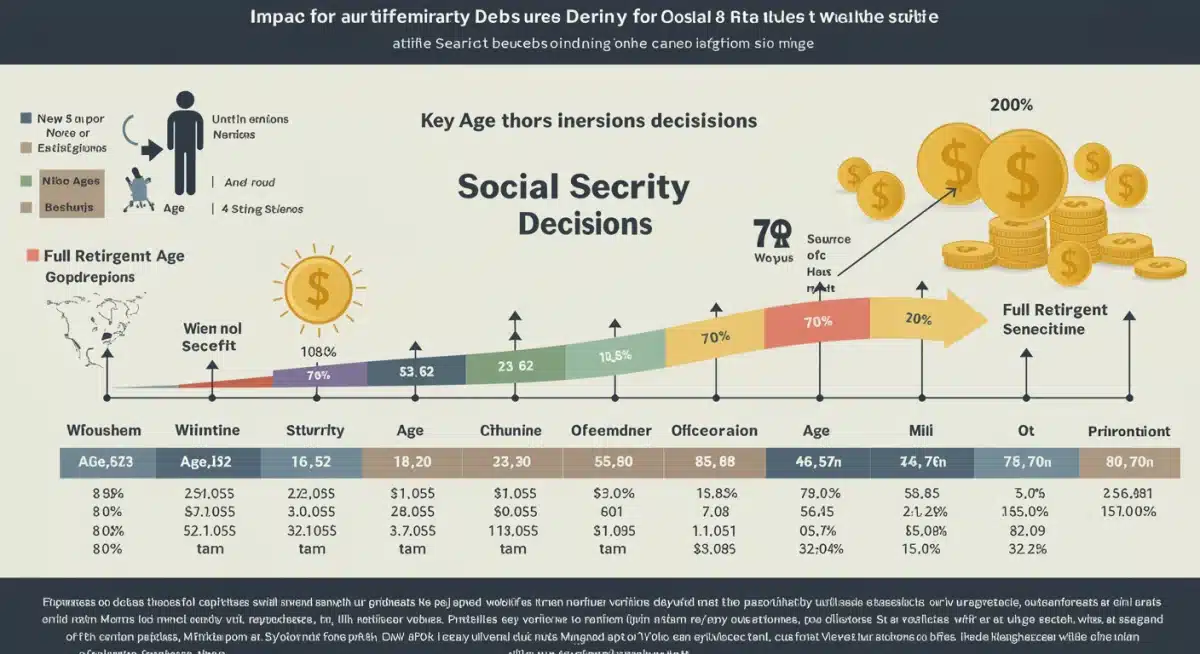
The most significant lever for achieving an 8% increase in your monthly Social Security payout often lies in your claiming decision. While you can start receiving benefits as early as age 62, doing so results in a permanent reduction. Conversely, delaying your claim beyond your Full Retirement Age (FRA) can lead to substantial increases.
Each year you delay claiming benefits past your FRA, up to age 70, your monthly payment increases by a certain percentage, known as delayed retirement credits. For those with an FRA of 67, delaying until age 70 can result in an approximately 24% higher monthly benefit compared to claiming at FRA. This annual accrual is approximately 8% per year.

Timing Your Claim: The Power of Delay
The decision of when to claim is highly personal and depends on several factors, including your health, other retirement income sources, and financial needs. However, from a purely mathematical perspective, delaying is often the most impactful strategy for increasing your monthly check.
- Full Retirement Age (FRA): Know your FRA. For those born in 1960 or later, it’s age 67. Claiming at FRA provides your full, unreduced benefit.
- Delayed Retirement Credits: For every year you delay claiming past your FRA, up to age 70, your benefit increases by 8% per year. This is a guaranteed increase that compounds over time.
- Spousal and Survivor Benefits: Consider how your claiming decision impacts potential spousal or survivor benefits. A higher benefit for you can mean higher benefits for your spouse or survivors.
While delaying benefits offers significant advantages, it requires careful financial planning to bridge the income gap between when you stop working and when you start claiming Social Security. This might involve utilizing personal savings, investments, or other retirement accounts.
Ultimately, strategically timing your Social Security claim is one of the most powerful tools available to optimize your benefits. By understanding the delayed retirement credits and planning for the interim, many individuals can achieve the desirable 8% increase in their monthly Social Security payout.
Impact of New Legislation and Policy Changes in 2026
The Social Security program is subject to ongoing legislative review, and changes can significantly impact future benefits. While the core structure of Social Security has remained stable, minor adjustments or comprehensive reforms can be enacted to address funding challenges or adapt to economic realities. For 2026, understanding any new legislation or policy shifts is crucial for those hoping to increase their monthly payout.
These changes could come in various forms, such as modifications to the benefit calculation formula, adjustments to the annual earnings limit, or even shifts in the eligibility criteria for certain benefit types. Staying informed about proposed and enacted legislation is paramount for effective financial planning.
Potential Legislative Scenarios
While specific legislative changes for 2026 are speculative until formally announced, several areas are often discussed in policy circles. These discussions can provide insight into potential future adjustments.
- Taxable Earnings Cap: Changes to the maximum amount of earnings subject to Social Security taxes could affect higher earners’ contributions and, consequently, their future benefits.
- Benefit Formula Adjustments: While less common, modifications to the primary insurance amount (PIA) formula could alter how benefits are calculated, impacting all future retirees.
- COLA Calculation Methods: Although COLA is generally tied to inflation, changes in how inflation is measured or the formula used could influence the annual benefit increases.
It is important to distinguish between routine adjustments, like COLA, and more substantial legislative reforms. The potential for an 8% increase in monthly payouts in 2026 could be a direct result of a favorable COLA, or it could be influenced by legislative actions designed to bolster benefits or address specific economic conditions.
Monitoring official announcements from the Social Security Administration (SSA) and reputable financial news sources will be key to understanding the precise nature of any new legislation or policy changes. Proactive engagement with these updates will empower individuals to adapt their retirement strategies accordingly and capitalize on opportunities to enhance their Social Security income.
Maximizing Your Benefits Beyond the 8% Goal
While an 8% increase in your monthly Social Security payout is an excellent goal for 2026, it’s important to recognize that a comprehensive approach to benefit optimization can yield even greater returns. Beyond simply delaying your claim, several other strategies can contribute to a more robust retirement income from Social Security.
These strategies often involve coordinating benefits with a spouse, understanding different benefit types, and making informed decisions about working during retirement. Each element, when carefully considered, adds another layer to your overall Social Security maximization plan.
Coordinating Spousal and Survivor Benefits
For married couples, strategic coordination of benefits can significantly increase the total household income from Social Security. This often involves one spouse delaying their claim to maximize their own benefit, which in turn can lead to a higher survivor benefit for the remaining spouse.
- Spousal Benefit Claiming: A spouse can claim a benefit based on their partner’s work record, potentially up to 50% of their partner’s full retirement amount. This can be beneficial if one spouse has a significantly lower earnings history.
- Survivor Benefits: Upon the death of a spouse, the surviving spouse may be eligible for benefits based on the deceased’s record, which could be higher than their own. Maximizing the higher earner’s benefit directly impacts the potential survivor benefit.
- “File and Suspend” (if applicable): While largely phased out, understanding its historical context and similar strategies for specific demographics can still be relevant for some.
Additionally, for those who continue to work in retirement, understanding the earnings limit and how it interacts with your benefits is crucial. Earning above the limit can lead to temporary benefit reductions, although these benefits are typically restored in full at your FRA.
By looking beyond the immediate 8% target and considering the broader spectrum of Social Security rules, individuals and couples can create a more resilient and higher-earning retirement plan, leveraging all available avenues for benefit maximization.
Financial Planning and Bridging the Income Gap
Successfully pursuing an 8% increase in your Social Security benefits, particularly through delayed claiming, requires meticulous financial planning to bridge the income gap. The period between stopping work and initiating Social Security benefits can be several years, and having a solid financial strategy for this interval is critical to avoid financial strain.
This planning involves assessing your current financial resources, understanding your spending needs in early retirement, and strategically drawing from other income sources. A well-executed plan ensures that delaying Social Security doesn’t create undue hardship but rather serves as a powerful tool for long-term financial security.
Strategies for Funding the Delay Period
Several financial vehicles and approaches can be utilized to cover expenses during the period you are delaying your Social Security claim. The most effective strategy will depend on your individual circumstances, risk tolerance, and existing assets.
- Personal Savings and Investments: Tapping into non-retirement savings accounts, taxable brokerage accounts, or even a portion of your emergency fund can provide short-term liquidity.
- Retirement Accounts (401(k), IRA): Strategically withdrawing from these accounts can fund your living expenses. Be mindful of tax implications and required minimum distributions (RMDs) if you are over 73.
- Part-time Work or Consulting: Engaging in part-time employment or consulting can provide supplemental income without fully re-entering the workforce, potentially allowing you to preserve other assets.
- Annuities: Certain types of annuities can provide a guaranteed income stream, which can be tailored to begin during your Social Security delay period.
It’s vital to create a detailed budget for this period, accounting for both essential and discretionary expenses. Understanding your burn rate will help you determine how much capital you need to set aside. Consulting with a financial advisor can provide personalized guidance, helping you model different scenarios and choose the most appropriate funding strategies.
The goal is to ensure that your decision to delay Social Security is financially sustainable, allowing you to reap the benefits of higher monthly payouts without compromising your quality of life in the interim. Effective financial planning is the cornerstone of a successful delayed claiming strategy.
Common Mistakes to Avoid When Claiming Benefits
While the prospect of increasing your Social Security benefits by 8% in 2026 is exciting, several common pitfalls can derail even the best-laid plans. Being aware of these mistakes and actively working to avoid them is just as important as understanding the optimization strategies themselves. A misstep can lead to permanently reduced benefits or missed opportunities for higher payouts.
Many of these errors stem from a lack of information, a misunderstanding of the rules, or making emotional decisions rather than financially sound ones. Education and careful consideration are your best defenses against these common traps.
Pitfalls to Navigate
Avoiding these common mistakes can help ensure your Social Security claiming strategy is as effective as possible and aligns with your long-term financial goals.
- Claiming Too Early: The most frequent mistake is claiming benefits at the earliest possible age (62) without fully understanding the permanent reduction this entails. This can significantly reduce your lifetime benefits.
- Not Checking Your Earnings Record: Failing to review your Social Security earnings statement for inaccuracies can lead to a lower benefit calculation. Correcting errors can boost your average earnings.
- Ignoring Spousal/Survivor Benefits: Married individuals often overlook the potential to coordinate benefits with a spouse or optimize survivor benefits, leaving money on the table.
- Underestimating Longevity: Some claim early due to health concerns, but improvements in life expectancy mean many will live longer than anticipated, making a higher monthly payout more valuable later in life.
- Failing to Plan for the Income Gap: As discussed, delaying benefits requires a plan to cover living expenses. Without this, individuals may be forced to claim early out of necessity.
Another mistake is failing to consult with a financial advisor or the Social Security Administration directly. These resources can provide personalized advice and clarify complex rules, ensuring your decisions are based on accurate information and tailored to your unique situation.
By proactively addressing these common errors, you can safeguard your Social Security benefits and position yourself to achieve the desired 8% increase, securing a more comfortable and financially stable retirement.
| Key Strategy | Brief Description |
|---|---|
| Delay Claiming | Delaying benefits past Full Retirement Age (FRA) up to age 70 can increase monthly payouts by 8% annually. |
| Maximize Earnings | Ensure 35 highest earning years are maximized and check earnings record for accuracy. |
| Coordinate Spousal Benefits | Married couples can strategically time claims to maximize combined household benefits and survivor payouts. |
| Bridge Income Gap | Plan financially to cover expenses during the period of delayed Social Security claiming. |
Frequently Asked Questions About 2026 Social Security Benefits
The potential 8% increase primarily stems from delayed retirement credits. For every year you delay claiming benefits past your Full Retirement Age (FRA) up to age 70, your monthly payment increases by approximately 8%, providing a significant boost to your overall payout.
Your Social Security benefit is calculated using your 35 highest-earning years. A strong and consistent earnings history, with high income up to the taxable maximum, will result in a higher Primary Insurance Amount (PIA) and thus a greater potential for increased benefits.
For those born in 1960 or later, the Full Retirement Age remains 67. Claiming at or after your FRA allows you to receive your full, unreduced benefit, and delaying past FRA (up to age 70) earns you delayed retirement credits, increasing your monthly payout.
To bridge the income gap, consider utilizing personal savings and investments, making strategic withdrawals from retirement accounts like 401(k)s or IRAs, or engaging in part-time work or consulting. Careful budgeting and financial planning are essential for this period.
Common mistakes include claiming benefits too early, failing to check your earnings record for accuracy, neglecting spousal or survivor benefit coordination, underestimating your longevity, and not adequately planning for the income gap if you delay your claim. Seek professional advice.
Conclusion
The opportunity to achieve an 8% increase in your monthly Social Security payout in 2026 is a tangible goal, primarily driven by strategic claiming decisions, particularly delaying benefits past your Full Retirement Age. However, maximizing your benefits requires a holistic approach that encompasses understanding eligibility, optimizing your earnings history, staying informed about legislative changes, and robust financial planning to bridge any income gaps. By avoiding common pitfalls and proactively engaging with these strategies, you can significantly enhance your retirement income and secure a more financially stable future, aligning your Social Security benefits with your long-term financial aspirations.