Federal Student Loan Repayment Plans 2026: Save Thousands

The landscape of federal student loan repayment is constantly evolving, and for millions of borrowers, the year 2026 marks a significant turning point. With new policies and adjustments coming into full effect, understanding these changes is not just beneficial, but absolutely critical to managing your financial future. The goal of this comprehensive guide is to decode the new federal student loan repayment plans for 2026, providing you with the knowledge and strategies to potentially save thousands of dollars over the life of your loans.
Student debt has become a pervasive issue for many, impacting everything from homeownership dreams to retirement planning. The U.S. Department of Education has been working to reform the system, aiming to make repayment more manageable and accessible. These reforms, particularly the full implementation of the Saving on a Valuable Education (SAVE) Plan, promise to fundamentally alter how borrowers approach their student debt.
Whether you’re a recent graduate, a seasoned professional still carrying student debt, or a parent navigating PLUS loans, the information presented here will be invaluable. We’ll break down the intricacies of the new plans, highlight the key differences from previous options, and offer actionable advice on how to optimize your repayment strategy. Get ready to embark on a journey that could lead to significant financial relief and a clearer path to debt freedom.
Decoding the New Federal Student Loan Repayment Plans: A 2026 Guide to Saving Thousands
The Evolution of Federal Student Loan Repayment
Before diving into the specifics of 2026, it’s essential to understand the historical context of federal student loan repayment. For decades, borrowers have had various options, primarily standard repayment, graduated repayment, extended repayment, and several income-driven repayment (IDR) plans. These IDR plans – Income-Based Repayment (IBR), Pay As You Earn (PAYE), and Income-Contingent Repayment (ICR) – were designed to make monthly payments affordable by capping them at a percentage of a borrower’s discretionary income. However, they often came with complexities, including interest capitalization and varying forgiveness timelines, which sometimes left borrowers feeling trapped.
The need for reform became increasingly apparent, leading to initiatives aimed at simplifying the system and providing more substantial relief. The most significant of these reforms culminated in the introduction and gradual implementation of the SAVE Plan, which is set to reach its full potential by July 2026. This plan represents a paradigm shift, focusing on reducing monthly payments, preventing interest capitalization, and accelerating forgiveness for many borrowers.
Understanding this evolution is crucial because many borrowers will be transitioning from older IDR plans to the SAVE Plan, or evaluating it against their current standard repayment options. The changes are not merely incremental; they are designed to fundamentally reshape the financial burden of student loans for millions of Americans. By 2026, the full impact of these changes will be felt, making it imperative for borrowers to be fully informed and proactive.
Introducing the SAVE Plan: Your Best Bet for 2026
The Saving on a Valuable Education (SAVE) Plan is the cornerstone of the new federal student loan repayment landscape for 2026. It’s an enhanced income-driven repayment plan that offers the most generous terms ever available to federal student loan borrowers. If you’re currently on another IDR plan or considering one, the SAVE Plan should be your primary focus.
Key Features of the SAVE Plan Fully Implemented by July 2026:
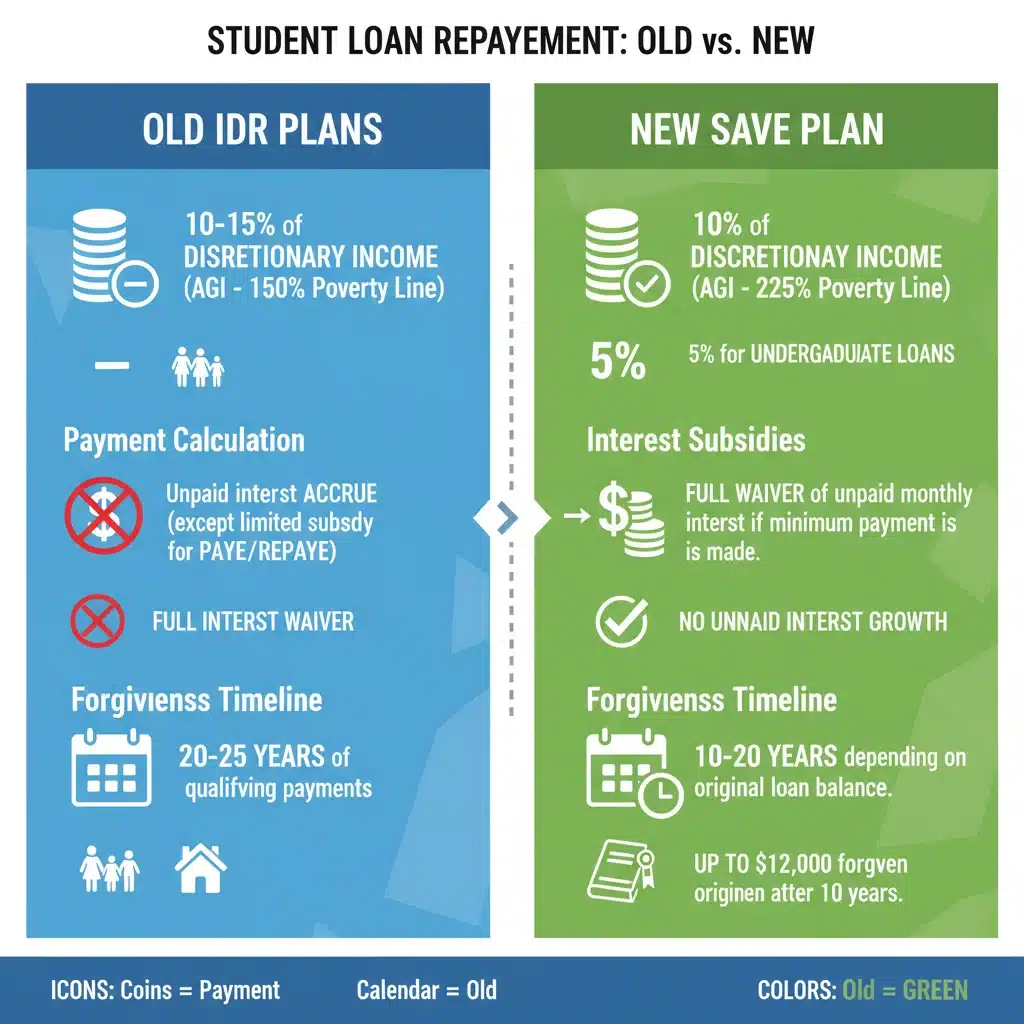
- Lower Monthly Payments: For undergraduate loans, monthly payments will be cut in half, from 10% to 5% of discretionary income. This is a massive reduction that can free up significant funds in a borrower’s budget. Borrowers with both undergraduate and graduate loans will pay a weighted average between 5% and 10%.
- No Unpaid Interest Growth: This is perhaps one of the most revolutionary aspects of the SAVE Plan. If your calculated monthly payment doesn’t cover the full amount of interest accrued, the government will cover the remaining interest. This means your loan balance will not grow due to unpaid interest, a common frustration and financial trap in previous IDR plans.
- Higher Discretionary Income Threshold: The amount of income considered “discretionary” is increased from 150% to 225% of the federal poverty line. This means more of your income is protected, leading to even lower monthly payments for many.
- Faster Forgiveness for Smaller Balances: Borrowers with original principal balances of $12,000 or less will receive loan forgiveness after just 10 years of payments, instead of 20 or 25 years. For every additional $1,000 borrowed above $12,000, an additional year of payments is added, up to the standard 20 or 25 years.
- Exclusion of Spousal Income (for married borrowers filing separately): If you are married and file your taxes separately, your spouse’s income will no longer be included in the calculation of your monthly payment. This offers significant relief for many married borrowers.
- Automatic Enrollment for Defaulted Borrowers: Borrowers who default on their loans will be automatically enrolled in the SAVE Plan after successfully completing a rehabilitation program, providing a smoother transition back into good standing.
These features collectively make the SAVE Plan a game-changer for student loan borrowers. For many, it will mean substantially lower monthly payments, an end to the dreaded balance growth from accruing interest, and a clearer, faster path to forgiveness. It’s designed to be the most affordable IDR plan, providing a safety net for those struggling with high debt burdens relative to their income.
Comparing SAVE to Other Repayment Options in 2026
While the SAVE Plan is poised to be the most beneficial option for many, it’s still important to understand where it stands in relation to other available repayment plans. Knowing the differences will help you make an informed decision about the best path for your specific financial situation.
Standard Repayment Plan:
This remains the default plan for most federal loans. Payments are fixed and designed to pay off your loan within 10 years (or up to 30 years for consolidated loans). While it incurs the least amount of interest over the life of the loan, monthly payments can be high, especially for those with significant debt. For borrowers who can comfortably afford the payments, this remains a good option to pay off debt quickly.
Graduated Repayment Plan:
Payments under this plan start lower and gradually increase, typically every two years. The loan is still paid off within 10 years (or up to 30 years for consolidated loans). This plan can be useful for borrowers who expect their income to rise steadily over time, but it results in more interest paid overall compared to the Standard Plan.
Extended Repayment Plan:
Available to borrowers with more than $30,000 in federal student loan debt, this plan allows for up to 25 years of fixed or graduated payments. It lowers monthly payments significantly compared to the Standard Plan but results in substantially more interest paid over the longer term.
Other Income-Driven Repayment (IDR) Plans (IBR, PAYE, ICR):
While the SAVE Plan is the newest and generally most advantageous, other IDR plans still exist for certain borrowers or specific circumstances. However, for most, SAVE will offer more favorable terms, particularly due to the lower discretionary income percentage (5% vs. 10-15%) and the crucial interest subsidy.
- Income-Based Repayment (IBR): Payments are generally 10% or 15% of discretionary income, depending on when you took out your loans, and are forgiven after 20 or 25 years. Interest capitalization can occur.
- Pay As You Earn (PAYE): Payments are 10% of discretionary income and are forgiven after 20 years. Similar to IBR, interest can capitalize.
- Income-Contingent Repayment (ICR): Payments are either 20% of discretionary income or what you’d pay on a fixed 12-year plan, whichever is less. Forgiveness occurs after 25 years. This is generally the least generous IDR plan.
For most borrowers, especially those with undergraduate loans, the SAVE Plan will offer lower monthly payments and better interest terms than IBR, PAYE, or ICR. It’s crucial to compare your potential payments under SAVE with any other IDR plan you might be on or considering. The elimination of interest capitalization alone makes SAVE a superior choice for many.
Who Benefits Most from the SAVE Plan in 2026?
The SAVE Plan is designed to provide relief across a broad spectrum of borrowers, but certain groups stand to benefit the most from its full implementation in 2026:
- Low- to Middle-Income Earners: With the increased discretionary income threshold and the 5% payment cap for undergraduate loans, individuals with modest incomes will see their payments drastically reduced, often to $0.
- Borrowers with High Debt-to-Income Ratios: If your student loan balance is high relative to your income, the SAVE Plan will significantly lower your monthly burden and prevent your balance from growing due to interest.
- Recent Graduates: Those just starting their careers with entry-level salaries will find the SAVE Plan immensely helpful in managing their initial loan payments as they establish themselves financially.
- Married Borrowers Filing Separately: The exclusion of spousal income for those who file taxes separately is a huge advantage, allowing payments to be calculated solely on the individual borrower’s income.
- Borrowers with Smaller Original Loan Balances: The accelerated forgiveness timeline for balances under $12,000 (and scaling up from there) means debt freedom can come much sooner for a significant portion of borrowers.
- Public Service Workers: While PSLF (Public Service Loan Forgiveness) is a separate program, being on an IDR plan like SAVE is a prerequisite. The lower payments under SAVE will make it easier for public service workers to meet their 120 qualifying payments without financial strain.
Essentially, if you are struggling with student loan payments, or if your payments feel burdensome relative to your income, the SAVE Plan is very likely your best option moving forward into 2026. It provides a robust safety net and a clearer path to eventual debt relief.
Strategies to Maximize Your Savings with the New Plans
Knowing about the new plans is one thing; actively using them to save thousands is another. Here are actionable strategies to ensure you’re making the most of the federal student loan repayment changes in 2026:
1. Enroll in the SAVE Plan Immediately (if eligible)
Don’t wait until 2026. Many key benefits of the SAVE Plan are already in effect. If you’re on another IDR plan or struggling with standard payments, apply for SAVE today. The earlier you enroll, the sooner you can start benefiting from lower payments and the interest subsidy.
2. Re-evaluate Your Loan Consolidation Strategy
If you have older federal loans (like FFEL Program loans) that aren’t eligible for SAVE, consider consolidating them into a Direct Consolidation Loan. This will make them eligible for the SAVE Plan. Be mindful of the “fresh start” initiative that allowed defaulted loans to be brought into good standing, and check if you can still benefit from consolidating older loans to capture past payments towards forgiveness through the IDR Account Adjustment.
3. Understand Your Discretionary Income Calculation
The SAVE Plan uses 225% of the federal poverty line to define discretionary income. Familiarize yourself with this threshold for your family size. The higher this threshold, the lower your calculated discretionary income, and thus, your monthly payment. For many, this means a significant portion of their income is protected.
4. File Taxes Separately if Married (and it benefits you)
If you’re married, filing taxes separately can be a powerful strategy under the SAVE Plan. This ensures only your income is used to calculate your payment, potentially leading to much lower monthly obligations. Weigh this against any tax benefits you might lose by not filing jointly.
5. Recertify Your Income Annually (and on time)
To keep your payments accurate and avoid interest capitalization (which can still occur if you miss your recertification deadline), make sure to recertify your income and family size annually. Your loan servicer will notify you when it’s time.
6. Track Your Payments Towards Forgiveness
For those aiming for IDR forgiveness (20 or 25 years) or PSLF (10 years), keep meticulous records of your payments. The Department of Education is working to provide better tracking, but it’s always wise to have your own records. The IDR Account Adjustment (often called the one-time adjustment) is critical here, as it retroactively counts many past periods towards forgiveness that previously didn’t qualify. Ensure your account is reviewed for this adjustment.
7. Consider Public Service Loan Forgiveness (PSLF)
If you work for a qualifying government or non-profit organization, the PSLF program can forgive your remaining federal student loan balance after 120 qualifying payments (10 years) under an IDR plan like SAVE. The lower payments under SAVE make PSLF even more attainable for many public service workers.
8. Stay Informed and Communicate with Your Servicer
Federal student loan policies can change. Regularly check official Department of Education websites and communicate with your loan servicer. Don’t rely solely on third-party information; always verify. If you have questions, reach out to your servicer directly.

Understanding the Impact on Different Loan Types
While the SAVE Plan offers broad benefits, it’s important to understand how different federal loan types are affected, especially as we approach 2026.
Direct Loans:
These are the most common type of federal student loans and are fully eligible for the SAVE Plan. This includes Direct Subsidized Loans, Direct Unsubsidized Loans, Direct PLUS Loans (for graduate/professional students), and Direct Consolidation Loans.
FFEL Program Loans:
Federal Family Education Loan (FFEL) Program loans are not directly eligible for the SAVE Plan. To access SAVE’s benefits, borrowers with FFEL loans must consolidate them into a Direct Consolidation Loan. This is a critical step for many older borrowers.
Perkins Loans:
Federal Perkins Loans are also not directly eligible for the SAVE Plan. Like FFEL loans, they must be consolidated into a Direct Consolidation Loan to become eligible.
Parent PLUS Loans:
Parent PLUS loans are a bit more complex. They are not directly eligible for any IDR plan, including SAVE. However, a Parent PLUS loan can become eligible for the Income-Contingent Repayment (ICR) Plan if it is first consolidated into a Direct Consolidation Loan. To make a Parent PLUS loan eligible for the SAVE Plan, it requires a “double consolidation” strategy, where the initial consolidated loan is then consolidated again. This is a nuanced process that borrowers should discuss with their loan servicer or a trusted financial advisor, as it can be complex to execute correctly.
It’s crucial for borrowers to identify their loan types and understand the necessary steps to make them eligible for the most advantageous repayment options, especially the SAVE Plan. The Department of Education’s website (StudentAid.gov) is the definitive resource for checking your loan types and exploring consolidation options.
Common Pitfalls to Avoid in 2026
While the new repayment plans offer significant advantages, there are still potential pitfalls that borrowers should be aware of to avoid unnecessary financial setbacks:
- Ignoring Communication from Your Servicer: Loan servicers send important notices about your repayment plan, recertification deadlines, and other critical information. Don’t dismiss these communications.
- Missing Recertification Deadlines: Failing to recertify your income and family size annually for an IDR plan can lead to your payments reverting to the higher standard amount and potentially cause interest capitalization, negating one of SAVE’s biggest benefits.
- Not Understanding Consolidation Implications: While consolidation can be beneficial for making older loans eligible for SAVE, it also creates a new loan with a new interest rate (a weighted average of your old rates) and can reset your payment count towards forgiveness if not done carefully, especially with the IDR Account Adjustment in mind.
- Choosing the Wrong Plan: While SAVE is generally excellent, it might not be the absolute best for everyone, particularly those with very high incomes and low debt who can pay off their loans quickly under a Standard Plan. Always compare.
- Falling for Scams: Be wary of companies promising “guaranteed loan forgiveness” or charging fees for services you can get for free from your loan servicer or StudentAid.gov.
- Not Updating Your Contact Information: Ensure your loan servicer always has your current mailing address, email, and phone number so you don’t miss vital updates.
Proactive engagement and careful review of your options are your best defenses against these pitfalls. The Department of Education and your loan servicer are your primary resources for accurate information and assistance.
The Future of Student Loan Repayment Beyond 2026
While 2026 marks a significant milestone with the full rollout of the SAVE Plan, the conversation around student loan debt is ongoing. It’s reasonable to expect that further adjustments, debates, and perhaps even new legislation may emerge in the years to come. Staying informed means not just understanding the current rules, but also keeping an eye on future developments.
The current administration has made clear its commitment to making higher education more affordable and manageable, and the SAVE Plan is a testament to that. However, political landscapes can shift, and economic conditions can change, potentially influencing future policy decisions. Borrowers should cultivate a habit of regularly checking official sources like StudentAid.gov and reputable financial news outlets for updates.
The long-term goal of these reforms is to create a more equitable and sustainable student loan system. For individual borrowers, this means a greater opportunity to achieve financial stability, pursue their careers without crippling debt, and contribute positively to the economy. By leveraging the tools available in 2026, you’re not just managing your debt; you’re actively shaping your financial future.
Conclusion: Take Control of Your Student Debt in 2026
The year 2026 brings an unprecedented opportunity for federal student loan borrowers to significantly reduce their financial burden and save thousands of dollars. The full implementation of the SAVE Plan, with its dramatically lower payments, interest subsidy, and accelerated forgiveness options, represents the most substantial reform to federal student loan repayment in decades.
By understanding the nuances of the SAVE Plan, comparing it against other options, and proactively engaging with your loan servicer, you can take control of your student debt. Don’t let complexity deter you; the potential savings and peace of mind are well worth the effort of becoming informed.
Remember to:
- Act early: Enroll in SAVE if eligible, even before 2026.
- Consolidate wisely: Ensure all eligible loans can access SAVE benefits.
- Stay vigilant: Recertify income annually and track your progress toward forgiveness.
- Seek guidance: Use official resources and talk to your servicer for personalized advice.
This guide has equipped you with the essential knowledge to navigate the new federal student loan repayment plans in 2026. Now, it’s time to put this knowledge into action. By doing so, you’re not just managing debt; you’re investing in your financial freedom and future success.