Treasury Bonds 2026 Outlook: Navigating a 4% Yield Environment
The financial landscape is ever-evolving, and for fixed-income investors, understanding the future trajectory of interest rates and bond yields is paramount. As we cast our gaze towards 2026, a critical question emerges: what does a sustained 4% yield on Treasury bonds mean for investment strategies and portfolio construction? This comprehensive guide will delve into the multifaceted factors influencing Treasury bonds 2026, offering insights into economic indicators, monetary policy, and actionable strategies for navigating this environment.
Understanding the 4% Yield Environment for Treasury Bonds 2026
A 4% yield on Treasury bonds, particularly for longer-duration instruments, represents a significant shift from the ultra-low yield environment that characterized much of the past decade. This level of yield can be a double-edged sword: it offers more attractive income potential for new investments but can also signal underlying economic pressures or a more aggressive monetary policy stance. For investors focused on Treasury bonds 2026, comprehending the drivers behind this yield level is the first step towards informed decision-making.
Historical Context and Current Trajectory
To appreciate the significance of a 4% yield for Treasury bonds 2026, it’s essential to consider historical trends. For many years post-2008 financial crisis, central banks maintained exceptionally low interest rates to stimulate economic growth. This led to historically low bond yields, often below 2% for benchmark 10-year Treasuries. The recent period has seen a reversal, driven by persistent inflation and central bank efforts to bring it under control through interest rate hikes. This upward trajectory in yields has brought us closer to, and at times above, the 4% threshold, setting a new baseline for Treasury bonds 2026.
Key Drivers of Yields: Inflation and Monetary Policy
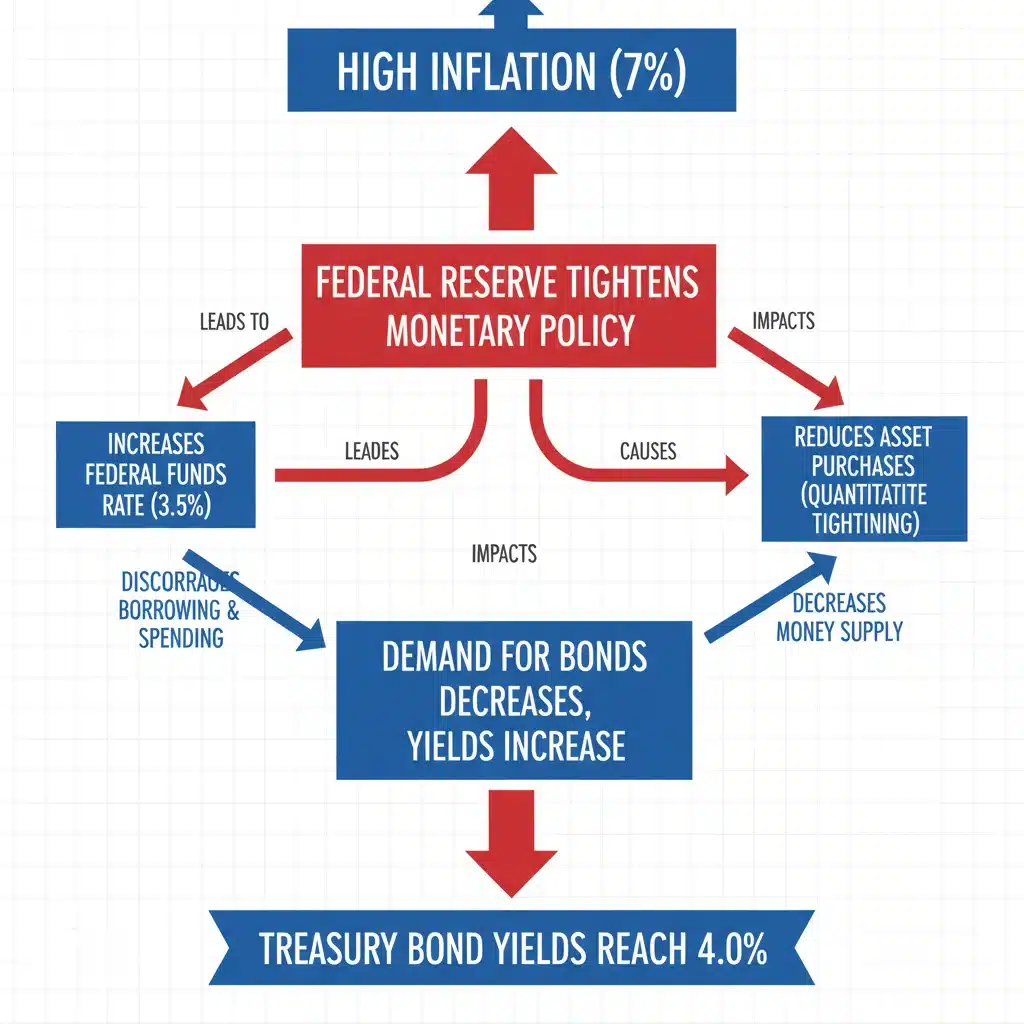
The primary architects of the current yield environment are inflation and the Federal Reserve’s monetary policy. When inflation is high, investors demand higher yields to compensate for the erosion of purchasing power. The Federal Reserve, in its mandate to maintain price stability, responds by raising the federal funds rate, which in turn influences bond yields across the curve. The market’s expectation of future inflation and the Fed’s reaction function are critical in determining where Treasury bonds 2026 yields will settle. A sustained 4% yield suggests that either inflation is expected to remain elevated, or the Fed will maintain a tighter monetary policy for an extended period, or a combination of both.
Economic Indicators Shaping Treasury Bonds 2026
Forecasting the path of Treasury bonds 2026 requires a keen understanding of various economic indicators. These data points provide clues about the health of the economy, inflation pressures, and the likely direction of monetary policy.
Inflation Data: CPI and PCE
Consumer Price Index (CPI) and Personal Consumption Expenditures (PCE) are the two most closely watched inflation gauges. Persistent high readings in these indicators would likely underpin a sustained 4% yield for Treasury bonds 2026. Conversely, a consistent decline in inflation could prompt the Fed to ease its stance, potentially leading to lower yields. Investors must monitor these reports closely, paying attention not just to headline numbers but also to core inflation, which excludes volatile food and energy prices.
Employment Figures: Jobs Reports and Wage Growth
A robust labor market, characterized by low unemployment and strong wage growth, can contribute to inflationary pressures. If the job market remains tight, it gives the Fed less reason to cut rates, supporting higher yields for Treasury bonds 2026. Conversely, a weakening labor market could signal an impending economic slowdown, potentially leading to rate cuts and lower bond yields. The monthly jobs report, including non-farm payrolls and average hourly earnings, is a crucial release.
GDP Growth and Recession Risks
The overall health of the economy, as measured by Gross Domestic Product (GDP) growth, also plays a significant role. A strong economy can tolerate higher interest rates, allowing yields to remain elevated. However, if economic growth falters or a recession looms, the Fed might be compelled to reduce rates, which would put downward pressure on Treasury bonds 2026 yields. Investors need to weigh the probabilities of various economic scenarios when assessing the future of bond yields.
Global Economic Landscape and Geopolitical Events
It’s important not to overlook the global context. International economic growth, trade relations, and geopolitical events can all influence the demand for safe-haven assets like U.S. Treasury bonds. During periods of global uncertainty, demand for Treasuries typically increases, which can temporarily push yields lower. Conversely, a synchronized global recovery could reduce demand for safe havens, supporting higher yields. The interplay of these global factors with domestic economic conditions will shape the environment for Treasury bonds 2026.
Monetary Policy: The Federal Reserve’s Role in Treasury Bonds 2026
The Federal Reserve’s actions and communications are arguably the single most influential factor in determining the trajectory of Treasury bonds 2026. Their dual mandate of maximum employment and price stability guides their decisions on interest rates and quantitative easing/tightening.
Federal Funds Rate and Forward Guidance
The federal funds rate is the benchmark interest rate, and changes to it directly impact short-term Treasury yields and indirectly influence longer-term yields. The Fed’s forward guidance – their communication about future policy intentions – is also critical. If the Fed signals a ‘higher for longer’ stance on rates, it reinforces the likelihood of sustained 4% yields for Treasury bonds 2026. Conversely, any hint of potential rate cuts could swiftly alter market expectations.
Quantitative Tightening (QT) and the Balance Sheet
Beyond interest rates, the Fed’s balance sheet policy, known as quantitative tightening (QT), also impacts bond supply and demand. By allowing bonds to mature without reinvesting the proceeds, the Fed effectively removes liquidity from the financial system and increases the supply of bonds available to the public, which can put upward pressure on yields. The pace and duration of QT will be an important consideration for Treasury bonds 2026.
Market Expectations vs. Fed Reality
There’s often a disconnect between what the market anticipates the Fed will do and what the Fed actually does. This ‘Fed pivot’ speculation can lead to volatility in bond yields. For Treasury bonds 2026, investors must carefully analyze the Fed’s official statements, speeches by Fed officials, and economic projections to gauge the true likelihood of various policy outcomes, rather than solely relying on market sentiment.
Implications of a 4% Yield for Fixed-Income Investors
A 4% yield environment for Treasury bonds 2026 presents both opportunities and challenges for fixed-income investors. Understanding these implications is crucial for adapting portfolios.
Attractive Income Opportunities
The most immediate benefit of higher yields is the increased income stream. For investors seeking yield, a 4% Treasury offers a considerably more attractive return than what was available just a few years ago. This can be particularly beneficial for retirees or those relying on fixed income for living expenses. Reinvesting these higher yields can also compound returns over time.
Duration Risk and Price Sensitivity
While higher yields are appealing, they also come with increased duration risk. Bond prices move inversely to yields. If yields rise further from 4%, existing bonds purchased at lower yields will see their market value decline. Longer-duration bonds are more sensitive to interest rate changes. Investors in Treasury bonds 2026 need to carefully consider their duration exposure and whether their portfolio can withstand potential further yield increases.
Rebalancing Portfolios: Bonds vs. Equities
A 4% yield on risk-free Treasury bonds makes them more competitive with equities, especially for investors focused on total return. This can lead to a re-evaluation of asset allocation, as the risk-adjusted returns of bonds become more appealing. Some investors might shift a portion of their portfolio from equities to fixed income to capture these higher yields with less volatility. This rebalancing act will be a key theme for Treasury bonds 2026.
Impact on Corporate Bonds and Other Fixed Income
Treasury yields serve as a benchmark for the broader fixed-income market. A 4% Treasury yield will likely push up yields on corporate bonds, municipal bonds, and other debt instruments. While this means higher income potential across the board, it also implies higher borrowing costs for corporations and governments. Investors in these segments must assess credit risk in addition to interest rate risk, as spreads over Treasuries will also be a critical factor. The impact on Treasury bonds 2026 will reverberate throughout the entire bond market.
Strategies for Navigating Treasury Bonds 2026
Given the outlook for Treasury bonds 2026 and the potential for sustained 4% yields, investors should consider several strategies to optimize their portfolios.
Laddering Strategies
Bond laddering involves staggering bond maturities across different timeframes. For example, an investor might buy bonds maturing in 1, 3, 5, and 7 years. As shorter-term bonds mature, the proceeds can be reinvested into longer-term bonds at prevailing (potentially higher) rates. This strategy helps mitigate interest rate risk by ensuring that not all investments are tied up in a single maturity, allowing for periodic reinvestment at current rates for Treasury bonds 2026.
Barbell Strategy
A barbell strategy involves investing in both very short-term and very long-term bonds, while avoiding intermediate maturities. The short-term bonds provide liquidity and allow for reinvestment at new rates, while the long-term bonds offer higher yields and potential for capital appreciation if rates eventually fall. This approach can be effective in a volatile yield environment, offering flexibility for Treasury bonds 2026.
Diversification Beyond Traditional Treasuries
While the focus is on Treasury bonds 2026, diversification remains a cornerstone of prudent investing. Consider diversifying within fixed income to include inflation-protected securities (TIPS), which offer protection against rising inflation, or high-quality corporate bonds if credit risk is deemed acceptable. Exploring global bonds can also offer diversification benefits, though currency risk must be considered.
Active vs. Passive Management
In a 4% yield environment, active management of fixed-income portfolios might gain an edge over passive strategies. Active managers can adjust duration, sector allocation, and credit quality more dynamically in response to changing market conditions and Fed policy. However, passive ETFs and funds still offer cost-effective exposure to the Treasury market for those who prefer a hands-off approach to Treasury bonds 2026.
Regular Portfolio Review and Adjustment
The economic landscape is fluid, and the outlook for Treasury bonds 2026 could shift. Regular review of your fixed-income portfolio is essential. Assess your risk tolerance, income needs, and investment horizon. Be prepared to adjust your strategy as new economic data emerges, and as the Federal Reserve communicates its policy intentions. Staying informed and flexible will be key to success.

Potential Risks and Challenges for Treasury Bonds 2026
While a 4% yield offers attractive returns, investors must also be aware of the potential risks and challenges that could impact Treasury bonds 2026.
Persistent Inflation
If inflation proves to be more persistent than anticipated, even a 4% yield might not offer sufficient real (inflation-adjusted) returns. This would erode purchasing power and could necessitate further tightening by the Fed, potentially pushing yields even higher and causing capital losses for existing bondholders. The battle against inflation is far from over, and its outcome will heavily influence Treasury bonds 2026.
Economic Slowdown or Recession
Conversely, a severe economic slowdown or recession could lead to a flight to safety, driving down Treasury yields. While this might benefit existing bondholders through capital appreciation, it would also signal broader economic distress and potentially impact other parts of an investor’s portfolio. The delicate balance between controlling inflation and avoiding a recession is a tightrope walk for policymakers, and its outcome will shape Treasury bonds 2026.
Fiscal Policy and Debt Levels
Government fiscal policy and the national debt also play a role. Large deficits and increasing debt issuance can put upward pressure on yields as the supply of Treasuries increases. While the U.S. Treasury market is vast and liquid, persistently high debt levels could, over the long term, influence investor perception and demand for Treasury bonds 2026.
Geopolitical Instability
Major geopolitical events, such as conflicts or trade wars, can introduce significant volatility into financial markets, including bonds. While Treasuries often act as a safe haven during such times, the nature and scale of the event can lead to unpredictable movements in yields. Investors must remain vigilant about global developments and their potential impact on Treasury bonds 2026.
Conclusion: Navigating the Future of Treasury Bonds 2026
The 2026 outlook for Treasury bonds, particularly in a sustained 4% yield environment, marks a pivotal moment for fixed-income investors. This landscape offers renewed opportunities for income generation but also demands a sophisticated understanding of economic forces, monetary policy, and risk management. By closely monitoring inflation, employment data, and the Federal Reserve’s actions, investors can make informed decisions.
Strategic approaches such as laddering, barbell strategies, and diversification will be crucial for optimizing portfolios. While the allure of a 4% yield is strong, investors must remain mindful of duration risk, the potential for persistent inflation, and broader economic challenges. The world of Treasury bonds 2026 is dynamic, and continuous adaptation and diligent research will be the hallmarks of successful investing in this new era of higher yields. Understanding these dynamics is not just about maximizing returns, but also about preserving capital and achieving long-term financial goals in a complex market.