US Treasury Bonds 2026: Yields, Projections & Secure Portfolio

In the dynamic world of finance, securing your investments against volatility is a paramount concern for both seasoned and novice investors. As we look towards 2026, one asset class consistently stands out for its perceived safety and reliability: US Treasury Bonds. These government-backed securities offer a unique blend of stability, liquidity, and predictable income, making them a cornerstone of many well-diversified portfolios. Understanding the landscape of US Treasury Bonds in 2026, including their current yields and future projections, is crucial for anyone aiming to build a robust and resilient financial strategy.
The global economic environment is perpetually in flux, influenced by geopolitical events, inflation, interest rate policies, and domestic economic performance. These factors directly impact the attractiveness and performance of US Treasury Bonds. For investors, the appeal of Treasuries often intensifies during periods of uncertainty, as they are considered one of the safest investments globally, backed by the full faith and credit of the US government. This comprehensive guide will delve deep into what makes US Treasury Bonds a compelling option for 2026, analyzing the factors that drive their yields, exploring various types of Treasuries, and offering insights into how they can fit into your investment strategy.
The Enduring Appeal of US Treasury Bonds
US Treasury Bonds 2026 continue to be a go-to asset for investors prioritizing capital preservation and stable income. Their appeal stems from several key characteristics:
- Safety and Security: As direct obligations of the US government, Treasuries carry virtually no default risk, making them one of the safest investments available.
- Liquidity: The Treasury market is one of the largest and most liquid financial markets in the world, allowing investors to buy and sell bonds with ease.
- Diversification: Treasuries often exhibit a low correlation with other asset classes like stocks, providing valuable diversification benefits that can reduce overall portfolio risk.
- Predictable Income: Most Treasury bonds pay fixed interest payments (coupons) semi-annually, offering a steady and predictable income stream.
However, like all investments, Treasuries are not without their nuances. Their returns can be modest compared to riskier assets, and their value can be sensitive to changes in interest rates. A thorough understanding of these dynamics is essential for effective investment planning.
Understanding US Treasury Bond Yields
The yield on a US Treasury Bond is a critical component for investors, representing the return an investor receives on their investment. Yields are influenced by a myriad of factors, making their prediction an intricate exercise. For US Treasury Bonds 2026, understanding these influences is particularly important.
Key Factors Influencing Yields:
- Federal Reserve Policy: The Federal Reserve’s monetary policy, particularly its decisions on the federal funds rate, has a profound impact on Treasury yields. When the Fed raises rates, bond yields generally tend to rise, and vice versa. Looking towards 2026, the Fed’s stance on inflation and economic growth will be a primary driver.
- Inflation Expectations: Inflation erodes the purchasing power of future fixed payments from bonds. If investors anticipate higher inflation, they will demand higher yields to compensate for this loss, pushing bond prices down and yields up.
- Economic Growth: Strong economic growth can lead to higher interest rates as demand for capital increases, potentially pushing Treasury yields higher. Conversely, a weakening economy might lead to lower yields as investors seek the safety of government bonds.
- Supply and Demand: The sheer volume of new Treasury issuance by the government to finance its spending, coupled with global demand from institutional and individual investors, also plays a significant role in determining yields.
- Global Economic Conditions: International capital flows and the economic health of other major economies can also influence US Treasury yields, as global investors shift capital in search of the best risk-adjusted returns.
For 2026, analysts will be closely watching the trajectory of inflation, the Fed’s response to it, and the overall health of the US and global economies to project yield movements. These projections are not mere academic exercises; they directly translate into the potential returns investors can expect from their Treasury holdings.
Types of US Treasury Securities for 2026
The US Treasury offers a variety of securities, each with distinct characteristics regarding maturity, interest payment structure, and inflation protection. Understanding these types is crucial when considering US Treasury Bonds 2026 for your portfolio.
- Treasury Bills (T-Bills): These are short-term securities with maturities ranging from a few days to 52 weeks. They are sold at a discount from their face value and do not pay interest until maturity. T-Bills are highly liquid and are often used for short-term cash management.
- Treasury Notes (T-Notes): T-Notes have intermediate maturities, typically 2, 3, 5, 7, and 10 years. They pay fixed interest every six months until maturity. The 10-year Treasury Note is often considered a benchmark for long-term interest rates.
- Treasury Bonds (T-Bonds): These are long-term securities with maturities of 20 or 30 years. Like T-Notes, they pay fixed interest every six months. T-Bonds are suitable for investors seeking long-term income streams.
- Treasury Inflation-Protected Securities (TIPS): TIPS are unique in that their principal value adjusts with changes in the Consumer Price Index (CPI), offering protection against inflation. They pay a fixed interest rate on their adjusted principal every six months. This feature makes them particularly attractive in periods of rising inflation expectations.
- Floating Rate Notes (FRNs): FRNs have a variable interest rate that adjusts quarterly based on a benchmark rate, such as the 13-week Treasury bill auction average. This provides investors with protection against rising interest rates.
When planning for 2026, the choice between these different types will depend on your investment horizon, risk tolerance, and inflation outlook. For instance, if you anticipate higher inflation, TIPS might be a more appealing option than traditional T-Notes or T-Bonds.
Current Yields and Market Outlook for US Treasury Bonds in 2026
Projecting current yields for US Treasury Bonds 2026 requires an analysis of the prevailing economic conditions and expert forecasts. While specific numbers are subject to constant change, we can discuss the likely trends and factors influencing them.
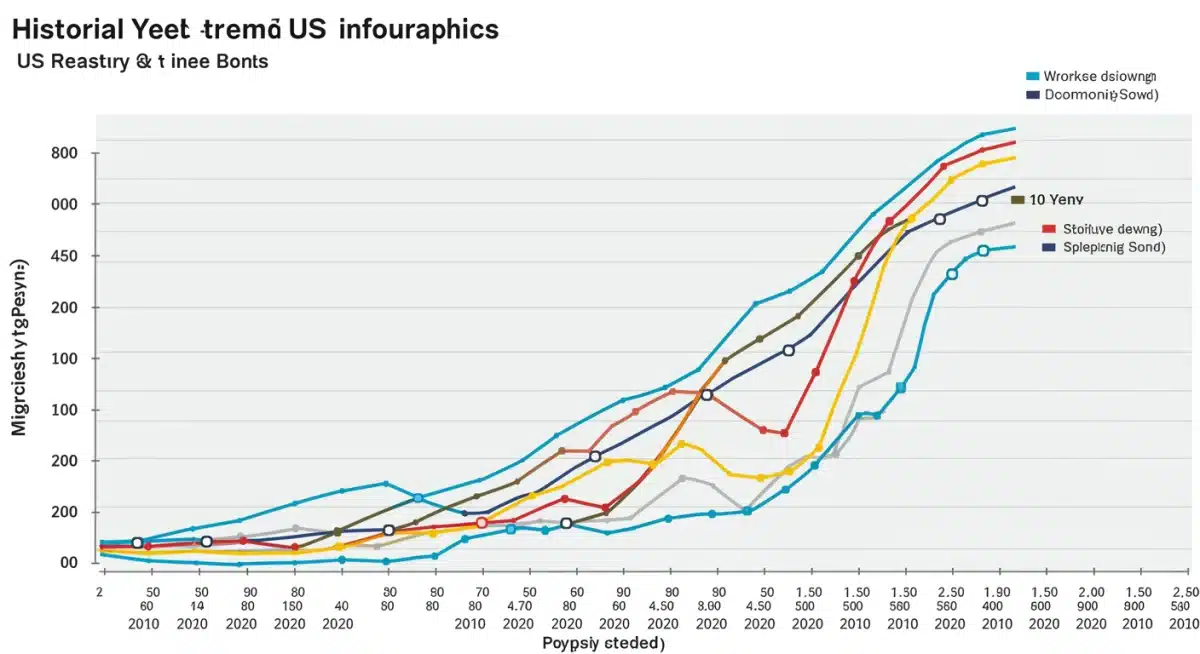
As of late, global central banks, including the Federal Reserve, have been navigating a complex environment characterized by persistent inflation and varying paces of economic recovery. This has led to a period of heightened interest rate volatility. The yield curve, which plots the yields of bonds with different maturities, is a key indicator. An inverted yield curve (where short-term yields are higher than long-term yields) has historically been a predictor of economic slowdowns or recessions, while a steepening curve often signals economic expansion.
Expert Projections and Scenarios for 2026:
- Scenario 1: Controlled Inflation and Stable Growth: If inflation moderates towards the Fed’s target and economic growth remains steady, we might see the Fed maintaining a relatively stable interest rate policy. In this scenario, Treasury yields could stabilize or even slightly decline from their peaks, offering moderate but reliable returns.
- Scenario 2: Persistent Inflation and Aggressive Fed: Should inflation prove more stubborn, the Fed might be compelled to maintain higher interest rates for longer or even implement further hikes. This would likely push Treasury yields higher across the curve, potentially leading to capital losses for existing bondholders but offering attractive entry points for new investors.
- Scenario 3: Economic Slowdown/Recession: In the event of a significant economic downturn, the Fed would likely cut interest rates to stimulate growth. This would typically lead to a sharp decline in Treasury yields, as investors flock to the safety of government bonds, driving up their prices.
It’s important to remember that these are scenarios, not guarantees. Investors should stay informed about economic data releases, central bank communications, and geopolitical developments that could shift these outlooks. The consensus among many economists suggests a gradual normalization of yields, but the path to 2026 will undoubtedly be influenced by unforeseen events.
Integrating US Treasury Bonds into Your Portfolio
For investors considering US Treasury Bonds 2026, strategic integration into an existing portfolio is key to maximizing their benefits. Treasuries can serve various roles, depending on your overarching investment goals.
Roles of Treasuries in a Portfolio:
- Capital Preservation: For those nearing retirement or with a low-risk tolerance, Treasuries offer an unparalleled level of safety for your principal.
- Income Generation: The fixed coupon payments from T-Notes and T-Bonds provide a reliable income stream, which can be particularly appealing in a low-yield environment for other income-generating assets.
- Portfolio Diversification: As mentioned, Treasuries often have a low or negative correlation with stocks. This means that when stocks decline, Treasuries may hold their value or even appreciate, providing a ballast to your portfolio.
- Inflation Protection: TIPS are specifically designed to protect against inflation, making them a valuable tool for preserving purchasing power in inflationary environments.
- Liquidity Management: T-Bills, with their short maturities, are excellent for parking cash that you may need in the near future, offering a small return without significant risk.
Strategies for Investing in Treasuries:
- Laddering: This strategy involves buying bonds with staggered maturity dates. As one bond matures, you reinvest the proceeds in a new long-term bond, maintaining a consistent income stream and reducing interest rate risk.
- Barbell Strategy: This involves investing in both very short-term and very long-term bonds, with little or no investment in intermediate-term bonds. This allows for liquidity from the short-term bonds and higher yields from the long-term bonds, while maintaining flexibility to react to interest rate changes.
- Target Maturity Strategy: If you have a specific financial goal in mind for 2026 (e.g., funding a child’s education or a down payment on a house), you can purchase a Treasury bond that matures around that time, ensuring the principal is available when needed.
Consulting with a financial advisor can help tailor these strategies to your individual financial situation and risk profile. They can provide personalized advice on how US Treasury Bonds 2026 can best serve your investment objectives.
Risks and Considerations for Treasury Investments in 2026
While US Treasury Bonds are lauded for their safety, they are not entirely risk-free. Investors must be aware of certain considerations, especially when planning for 2026 and beyond.
Primary Risks:
- Interest Rate Risk: This is the most significant risk for bondholders. If interest rates rise after you purchase a bond, the market value of your existing bond will fall. This is because new bonds will be issued with higher yields, making your lower-yielding bond less attractive. If you hold the bond to maturity, you will still receive your principal and all interest payments, but if you need to sell before maturity, you could incur a loss.
- Inflation Risk: For traditional (non-TIPS) Treasury bonds, unexpected inflation can erode the real value of your fixed interest payments and principal. While TIPS mitigate this, they are not entirely immune to other market forces.
- Reinvestment Risk: If interest rates fall, the income you receive from maturing bonds or coupon payments will be reinvested at lower rates, potentially reducing your overall returns over time.
Mitigating these risks involves careful planning and understanding your investment horizon. Longer-term bonds are generally more sensitive to interest rate changes than shorter-term bonds. Diversifying across maturities (e.g., using a laddering strategy) can help manage interest rate risk. For inflation protection, TIPS are a direct solution.
The Economic Backdrop and its Impact on 2026
The broader economic environment in the lead-up to and during 2026 will be a dominant force shaping the performance of US Treasury Bonds 2026. Key economic indicators and trends to monitor include:
- Inflation Data: The Consumer Price Index (CPI) and Personal Consumption Expenditures (PCE) index are crucial for understanding inflationary pressures and the Fed’s likely response.
- Employment Figures: Strong employment data can signal a robust economy, potentially leading to higher interest rates. Conversely, rising unemployment could prompt the Fed to ease monetary policy.
- GDP Growth: The pace of economic expansion or contraction directly influences corporate earnings and overall market sentiment, which in turn affects demand for safe-haven assets like Treasuries.
- Fiscal Policy: Government spending and taxation policies can impact the supply of new Treasury bonds and the overall economic trajectory. Large deficits often necessitate increased bond issuance.
- Geopolitical Events: Global conflicts, trade disputes, and other international developments can create uncertainty, increasing demand for safe assets and influencing capital flows into US Treasuries.
Staying abreast of these economic developments is not just for professional analysts; it empowers individual investors to make more informed decisions about their Treasury holdings. Regularly reviewing economic forecasts from reputable institutions can provide valuable context.
Purchasing US Treasury Bonds: A Practical Guide
Investing in US Treasury Bonds 2026 is accessible to individual investors through several channels.
Directly from TreasuryDirect:
TreasuryDirect is the US Treasury’s online platform where individuals can buy bonds directly from the government. This method avoids brokerage fees and is ideal for long-term holders. You can purchase T-Bills, T-Notes, T-Bonds, and TIPS through this platform.
Through a Brokerage Account:
Most major brokerage firms offer access to the Treasury market. This can be a convenient option if you already have an investment account and prefer to manage all your assets in one place. Brokerage firms typically offer a wider range of bond maturities and facilitate secondary market transactions.
Via Bond ETFs and Mutual Funds:
For investors who prefer a diversified approach without directly managing individual bonds, Treasury bond exchange-traded funds (ETFs) and mutual funds are excellent options. These funds hold portfolios of various Treasury securities, offering instant diversification and professional management. They are also highly liquid and can be bought and sold like stocks.
When purchasing, consider the bid-ask spread for market orders, especially in volatile markets. For direct purchases, understanding the auction process for new issues is important. Regardless of the method, ensure you understand the fees involved and how they might impact your overall returns.
The Role of US Treasury Bonds in a Retirement Portfolio
For many retirees or those planning for retirement, US Treasury Bonds 2026 represent a critical component of their financial strategy. The emphasis shifts from aggressive growth to capital preservation and income generation, areas where Treasuries excel.

In retirement, a steady stream of income to cover living expenses is paramount. T-Notes and T-Bonds, with their semi-annual interest payments, can provide this predictable income. Furthermore, their low correlation with equities can help cushion a retirement portfolio during stock market downturns, preventing significant drawdowns that can be difficult to recover from later in life.
TIPS are particularly valuable for retirees concerned about inflation eroding their fixed income. By adjusting their principal value with inflation, TIPS help preserve the purchasing power of retirement savings, a critical consideration in an environment where healthcare costs and other expenses are continually rising.
A common strategy for retirement portfolios is to gradually increase the allocation to fixed-income assets like Treasuries as one approaches and enters retirement. This shift reduces overall portfolio risk and enhances income stability, aligning the investment strategy with the changing financial needs and risk tolerance of retirees.
Future Projections and Long-Term Outlook Beyond 2026
While our focus is primarily on US Treasury Bonds 2026, it’s beneficial to consider the longer-term outlook. The factors influencing Treasury yields are not static; they evolve over time, driven by structural economic changes, technological advancements, and demographic shifts.
Looking beyond 2026, several long-term trends could shape the Treasury market:
- Demographics: An aging global population could increase demand for safe, income-generating assets, potentially putting downward pressure on yields if supply doesn’t keep pace.
- Technological Innovation: Advances in technology could impact productivity and economic growth, influencing long-term inflation and interest rate trends.
- Government Debt Levels: Persistently high levels of government debt could necessitate increased Treasury issuance, which might put upward pressure on yields if demand doesn’t match supply.
- Global Economic Interconnectedness: The increasing integration of global financial markets means that economic developments in one region can quickly impact bond markets worldwide, including US Treasuries.
- Climate Change and Green Finance: The growing focus on environmental sustainability could lead to new forms of government bonds (e.g., green bonds) and influence investor preferences, potentially impacting demand for traditional Treasuries.
These long-term trends introduce additional layers of complexity to yield projections. Investors with very long horizons should consider these structural shifts and how they might impact the risk-return profile of their fixed-income allocations. Regular portfolio reviews and adjustments will be key to navigating this evolving landscape.
Conclusion: Navigating the Future of US Treasury Bonds
Investing in US Treasury Bonds 2026 offers a compelling proposition for investors seeking security, liquidity, and predictable income. While the economic landscape is ever-changing, Treasuries have consistently served as a bedrock for diversified portfolios, providing a crucial hedge against market volatility and economic uncertainty.
Understanding the intricate interplay of economic indicators, Federal Reserve policy, inflation expectations, and global events is vital for anticipating yield movements and making informed investment decisions. Whether you choose to invest directly, through a brokerage, or via funds, the key is to align your Treasury investments with your overall financial goals, risk tolerance, and investment horizon.
As we move towards 2026, the careful integration of US Treasury Bonds into your investment strategy can help you build a resilient portfolio capable of weathering various economic cycles. By staying informed, diversifying wisely, and considering professional advice, you can harness the enduring strength of US government securities to secure your financial future.