Urgent Alert: Federal Tax Code Changes for Small Businesses 2026

Urgent Alert: Latest Changes to Federal Tax Code Affecting Small Businesses Starting January 2026
As a small business owner, you’re constantly juggling multiple responsibilities, from managing operations to nurturing customer relationships. Amidst this whirlwind, keeping an eye on legislative changes, especially those impacting your bottom line, can feel like another monumental task. However, ignoring these shifts can lead to significant financial repercussions. We’re issuing an urgent alert today because substantial federal tax code changes are on the horizon, set to take effect starting January 2026. These aren’t minor tweaks; they represent a significant overhaul that could profoundly impact your business’s financial health, operational strategies, and long-term viability.
The landscape of taxation is ever-evolving, and the U.S. federal tax code is no exception. With the approaching expiration of several key provisions from the Tax Cuts and Jobs Act (TCJA) of 2017, alongside new legislative initiatives, small businesses are facing a complex web of new rules and regulations. Understanding these impending federal tax code changes is not just about compliance; it’s about strategic planning, identifying opportunities for savings, and mitigating potential risks. Proactive preparation is not merely advisable; it’s essential for survival and growth in the coming years.
This comprehensive guide is designed to be your essential resource. We will delve into the specific federal tax code changes that are most likely to affect small businesses, break down their implications, and provide actionable strategies you can implement *now* to prepare. From corporate tax rates to individual income tax brackets that impact pass-through entities, from deductions and credits to international tax provisions, we’ll cover the critical aspects you need to know. Our goal is to empower you with the knowledge to navigate these changes confidently, ensuring your business not only complies but thrives amidst the new tax environment.
Understanding the Impetus Behind the Federal Tax Code Changes
Before diving into the specifics, it’s crucial to understand *why* these federal tax code changes are happening. The U.S. tax system is a dynamic entity, influenced by economic conditions, political priorities, and the need to fund government operations. The primary driver for many of the upcoming changes is the scheduled expiration of several provisions from the Tax Cuts and Jobs Act (TCJA) of 2017, many of which were temporary.
When the TCJA was enacted, certain provisions were given sunset dates, meaning they are set to expire unless Congress acts to extend them. As January 2026 approaches, these expirations will trigger a reversion to pre-TCJA law in many areas, or to new rules that Congress may enact in the interim. This creates a period of significant uncertainty but also an opportunity for strategic re-evaluation. Additionally, ongoing discussions about fiscal responsibility, infrastructure spending, social programs, and global tax harmonization efforts are contributing to the legislative momentum behind these impending federal tax code changes.
For small businesses, this legislative flux means that what worked for tax planning in 2024 or 2025 might be obsolete in 2026. Therefore, staying informed and adapting your strategies is paramount. The government’s objectives behind these changes often include stimulating economic growth, redistributing wealth, encouraging certain types of investments, or simply increasing federal revenue. Understanding these underlying motivations can sometimes help predict the direction of future tax policy and allow businesses to better position themselves.
Key Federal Tax Code Changes Expected in 2026 for Small Businesses
Let’s break down the most significant federal tax code changes that small businesses should be preparing for. While some details may still be subject to legislative debate, the broad outlines are becoming clear.
1. Individual Income Tax Rate Adjustments (Impact on Pass-Through Entities)
One of the most significant anticipated shifts involves individual income tax rates. Many small businesses operate as pass-through entities (S-corporations, partnerships, LLCs, and sole proprietorships), meaning their profits are taxed at the owner’s individual income tax rate. The TCJA significantly lowered individual income tax rates across various brackets. Unless extended, these rates are set to revert to higher, pre-TCJA levels. This means:
- Higher Taxable Income: Business owners may see a larger portion of their business income subjected to higher tax rates.
- Reduced Qualified Business Income (QBI) Deduction: The Section 199A deduction, which allows eligible pass-through entities to deduct up to 20% of their qualified business income, is also set to expire. Its absence or modification would directly increase the taxable income for many small business owners.
Action Item: Business owners operating as pass-through entities should model their tax liabilities under both current and potential future tax rate structures. Re-evaluate your compensation strategies, distribution policies, and consider whether a change in entity structure might become more advantageous.
2. Corporate Tax Rate Stability (for C-Corporations)
Unlike individual rates, the corporate tax rate was permanently reduced by the TCJA from a top rate of 35% to a flat 21%. Currently, there are no widespread proposals to significantly alter this rate for 2026. This provides a degree of stability for C-corporations. However, other corporate tax provisions might still see changes.
Action Item: C-corporations should continue to focus on optimizing deductions and credits available to them, as the core rate may remain stable, but the overall tax burden can still be influenced by other factors.
3. Changes to Itemized Deductions and Personal Exemptions
For many small business owners, especially sole proprietors, their personal tax situation is intertwined with their business. The TCJA eliminated personal exemptions and significantly increased the standard deduction. While the standard deduction might remain higher than pre-TCJA levels, there could be adjustments to the itemized deduction landscape. Limits on state and local tax (SALT) deductions, for instance, have been a contentious issue and could see revisions.
Action Item: Review your personal financial planning in conjunction with your business planning. Understand how potential changes to itemized deductions or the standard deduction could affect your overall tax liability, especially if you pass through significant business income.
4. Depreciation and Expensing Rules (Section 179 and Bonus Depreciation)
Small businesses heavily rely on depreciation and expensing provisions to reduce their taxable income when investing in new assets. The TCJA introduced 100% bonus depreciation, allowing businesses to immediately deduct the full cost of eligible new or used property. This bonus depreciation is scheduled to begin phasing out, starting with 80% in 2023, 60% in 2024, 40% in 2025, and 20% in 2026, before expiring in 2027. Section 179 expensing limits are also subject to annual inflation adjustments and could see legislative changes.
- Phasing Out Bonus Depreciation: The reduction in bonus depreciation means businesses will have to spread out deductions for asset purchases over several years, impacting cash flow and taxable income.
- Section 179 Limits: While Section 179 remains a powerful tool, its limits and phase-out thresholds are critical to monitor.
Action Item: Accelerate planned capital expenditures into 2024 or 2025 where feasible to take advantage of higher bonus depreciation rates. Re-evaluate your asset acquisition strategies and understand the long-term tax implications of purchasing equipment and property in 2026 and beyond.
5. Research and Development (R&D) Expensing
Since 2022, businesses have been required to amortize R&D expenses over five years (15 years for foreign R&D) instead of immediately expensing them. This change has significantly impacted many innovative small businesses. While there’s ongoing discussion in Congress about restoring immediate expensing, businesses should plan for the current amortization rule to continue unless legislation is passed.
Action Item: If your business incurs significant R&D expenses, factor the amortization requirement into your financial projections. Advocate for legislative changes if this impacts your ability to innovate, and explore other available credits for R&D.
6. Interest Expense Limitation (Section 163(j))
The TCJA also introduced limitations on the deduction of business interest expense under Section 163(j). For tax years beginning after December 31, 2021, the limitation tightened, generally capping deductible business interest at 30% of adjusted taxable income (ATI), calculated *without* the add-back of depreciation, amortization, and depletion. This makes the limitation more restrictive for many businesses.
Action Item: Businesses with significant debt or those planning major expansions financed by loans need to carefully analyze their interest expense deductions. Understand how this limitation affects your borrowing capacity and overall profitability. Consider strategies to reduce debt or restructure financing if necessary.
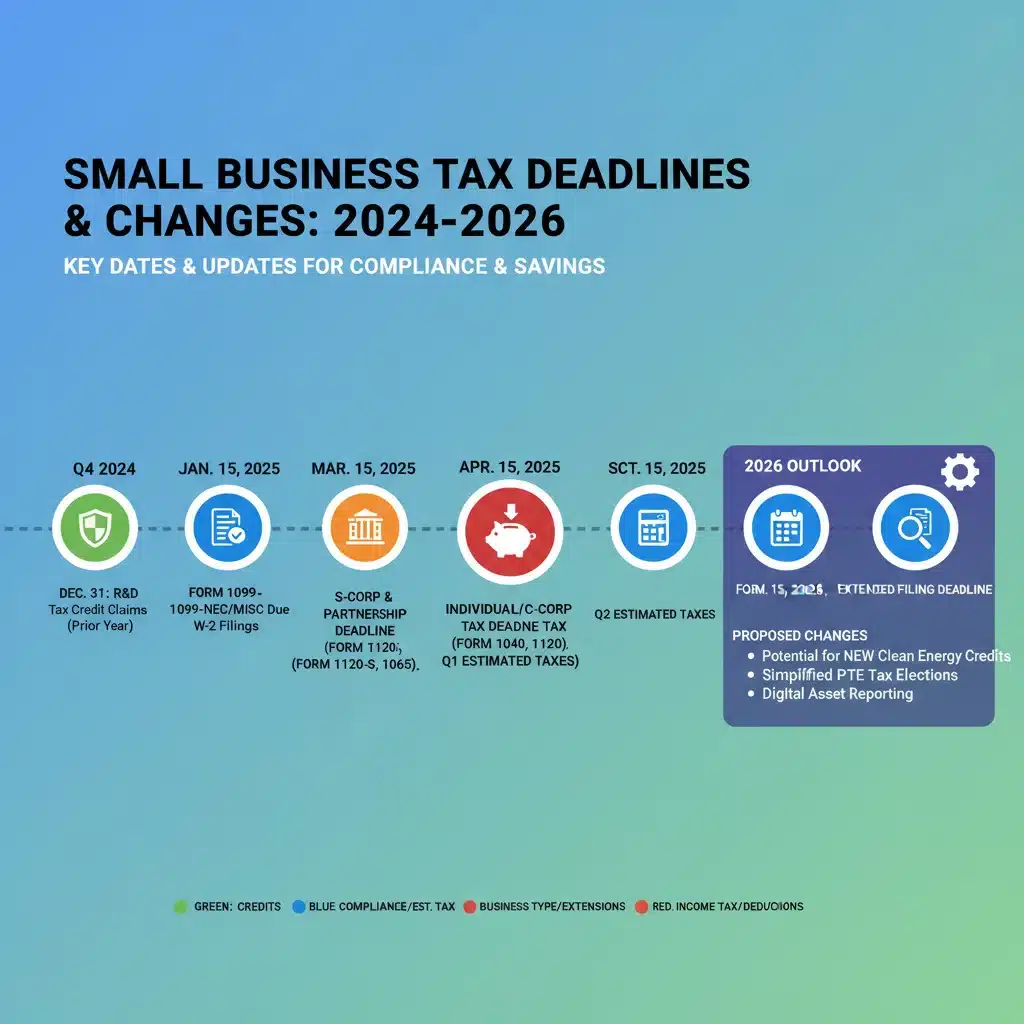
The Broader Economic and Legislative Context
It’s important to remember that these federal tax code changes don’t occur in a vacuum. The broader economic climate, including inflation, interest rates, and potential recessions, will influence both the final shape of tax legislation and how these changes impact your business. Furthermore, global tax initiatives, such as the OECD’s Pillar Two rules for a global minimum corporate tax, could eventually influence U.S. tax policy, even if their direct impact on most small businesses is indirect for now.
Political dynamics also play a crucial role. With upcoming elections, the composition of Congress and the White House could significantly alter the legislative agenda. While the sunset provisions of the TCJA are statutory, Congress always has the power to extend, modify, or replace them with entirely new legislation. This means that while we can anticipate certain changes, flexibility and continuous monitoring of legislative developments are key.
Proactive Strategies for Small Businesses to Navigate Federal Tax Code Changes
Given the complexity and potential impact of these impending federal tax code changes, a proactive approach is not just recommended, it’s mandatory. Here are actionable strategies you can implement starting today:
1. Engage with a Qualified Tax Professional Early
This is perhaps the most critical step. A knowledgeable CPA or tax advisor specializing in small business taxation can provide tailored advice based on your specific business structure, industry, and financial situation. They can help you:
- Model Scenarios: Project your tax liability under different legislative outcomes.
- Identify Opportunities: Uncover new deductions, credits, or strategies you might otherwise miss.
- Ensure Compliance: Help you navigate the complex regulatory landscape and avoid penalties.
Don’t wait until late 2025. Start these conversations now to allow ample time for planning and adjustments.
2. Review Your Business Structure
As individual tax rates potentially rise and the QBI deduction expires, the optimal business structure (sole proprietorship, partnership, S-Corp, C-Corp) might change for your business. For some, converting to a C-corporation might become more attractive if corporate rates remain stable and individual rates increase significantly. For others, retaining a pass-through structure with careful compensation planning might still be best.
Action: Consult with your tax advisor and legal counsel to evaluate if your current business entity structure remains the most tax-efficient choice for 2026 and beyond.
3. Optimize Capital Expenditure Planning
With bonus depreciation phasing out, the timing of significant asset purchases becomes crucial. If you have planned large equipment upgrades, vehicle purchases, or property improvements, consider accelerating these into 2024 or 2025 to maximize current depreciation benefits.
Action: Create a detailed capital expenditure plan for the next 2-3 years, factoring in the changing depreciation rules. Work with your financial team to assess cash flow implications.
4. Re-evaluate Compensation and Benefits Strategies
For pass-through entities, how owners are compensated (salary vs. distributions) can have significant tax implications, especially with changes to individual tax rates and potential QBI deduction expiration. Review your current compensation plans, including executive compensation, employee benefits, and retirement contributions, to ensure they remain tax-efficient under the new rules.
Action: Analyze the tax impact of owner salaries, distributions, and other benefits. Explore options like increasing contributions to qualified retirement plans to reduce taxable income.
5. Enhance Your Record-Keeping and Financial Reporting
Accurate and detailed financial records are always essential, but they become even more critical during periods of tax reform. Robust record-keeping will enable you to accurately claim deductions, track asset bases, and comply with new reporting requirements. Invest in accounting software and systems that can adapt to evolving tax laws.
Action: Ensure your accounting systems are up-to-date and your financial records are meticulously maintained. Consider adopting cloud-based accounting solutions for better accessibility and data integrity.
6. Stay Informed and Adaptable
Tax legislation is a moving target. Continuously monitor news from the IRS, Treasury Department, and reputable tax publications. Subscribe to newsletters from your tax advisor. Be prepared to adapt your plans as new information becomes available or as final legislation is passed.
Action: Dedicate time regularly to review tax news and updates. Attend webinars or seminars on upcoming tax changes. Build flexibility into your financial plans to pivot if necessary.
7. Conduct a Comprehensive Tax Impact Assessment
Work with your tax professional to perform a detailed assessment of how each of the anticipated federal tax code changes will specifically affect your business. This assessment should cover income taxes, payroll taxes, potential state and local tax implications (which often follow federal changes), and any industry-specific tax considerations.
Action: Request a formal tax impact analysis from your CPA, outlining potential liabilities and opportunities under various scenarios for 2026 and beyond.

The Importance of Long-Term Tax Planning
The impending federal tax code changes serve as a powerful reminder that tax planning should not be an annual, reactive exercise. Instead, it needs to be an ongoing, integral part of your overall business strategy. Long-term tax planning involves looking several years ahead, anticipating legislative shifts, and making strategic decisions today that will benefit your business tomorrow.
This includes:
- Succession Planning: How will tax changes impact the valuation and transfer of your business?
- Investment Decisions: How do tax incentives or disincentives influence your expansion plans, R&D investments, or technology upgrades?
- Cash Flow Management: Understanding future tax liabilities allows for better cash flow forecasting and management, preventing liquidity crunches.
- Risk Management: Proactive planning helps identify and mitigate tax-related risks, reducing the likelihood of audits or penalties.
By integrating tax considerations into every major business decision, you can build a more resilient and financially robust enterprise, capable of weathering legislative changes and thriving in any economic climate.
Conclusion: Act Now to Prepare for Federal Tax Code Changes
The message is clear: the significant federal tax code changes slated for January 2026 are not a distant concern; they require immediate attention and strategic planning. The potential for higher tax burdens, altered deduction landscapes, and new compliance requirements is real. However, with proactive engagement, expert guidance, and a commitment to adapting your business strategies, these challenges can be transformed into opportunities.
Don’t let these complex changes catch you off guard. Start the conversation with your tax advisor today. Review your business structure, optimize your capital expenditures, re-evaluate compensation, and ensure your financial records are impeccable. The businesses that prepare thoroughly and thoughtfully will be the ones that not only survive but also flourish in the evolving tax environment of 2026 and beyond. Your diligent preparation now will pay dividends in the years to come, securing the financial future and continued success of your small business.