Federal Grants for Students: Your 2024-2025 Guide to Funding Higher Education

For millions of aspiring students across the United States, the dream of higher education often comes with a significant financial hurdle. Tuition fees, living expenses, books, and supplies can quickly accumulate, making a college degree seem out of reach. However, a powerful resource exists to bridge this gap: Federal Student Grants. Unlike student loans, grants do not need to be repaid, making them an incredibly valuable form of financial aid that can significantly reduce the cost of your education.
In this comprehensive guide, we will demystify the process of securing Federal Student Grants for the 2024-2025 academic year. We’ll walk you through everything you need to know, from understanding what grants are and who is eligible, to the step-by-step application process and strategies for maximizing your chances of receiving funding. Whether you’re a first-time college applicant, a returning student, or considering a career change, this article is designed to equip you with the knowledge and tools to navigate the federal grant landscape effectively.
The landscape of financial aid can seem daunting, filled with acronyms and complex requirements. Our goal is to break down these complexities into easily digestible information, empowering you to confidently pursue the federal funding that can make your educational aspirations a reality. Let’s dive in and unlock the potential of Federal Student Grants!
Understanding Federal Student Grants: What They Are and Why They Matter
Before delving into the application process, it’s crucial to grasp the fundamental nature of Federal Student Grants. These are funds provided by the U.S. government to help eligible students pay for their education at colleges or career schools. The key distinction, and indeed their most attractive feature, is that they are considered ‘gift aid’ – money you typically do not have to repay. This stands in stark contrast to student loans, which accrue interest and must be paid back after graduation or leaving school.
The Core Purpose of Federal Student Grants
The primary purpose of Federal Student Grants is to make higher education accessible to students from all socioeconomic backgrounds. The government recognizes the value of an educated populace and aims to remove financial barriers that might otherwise prevent individuals from pursuing post-secondary education. By providing non-repayable funds, grants enable students to focus more on their studies and less on the burden of accumulating debt.
Who Benefits from Federal Student Grants?
While often associated with students demonstrating significant financial need, Federal Student Grants are available to a broad spectrum of individuals. Eligibility is primarily determined by financial need, but other factors such as academic merit, chosen field of study, and specific circumstances (e.g., being a veteran or a student with disabilities) can also play a role. Understanding these criteria is the first step toward successfully securing this vital funding.
Key Types of Federal Student Grants for 2024-2025
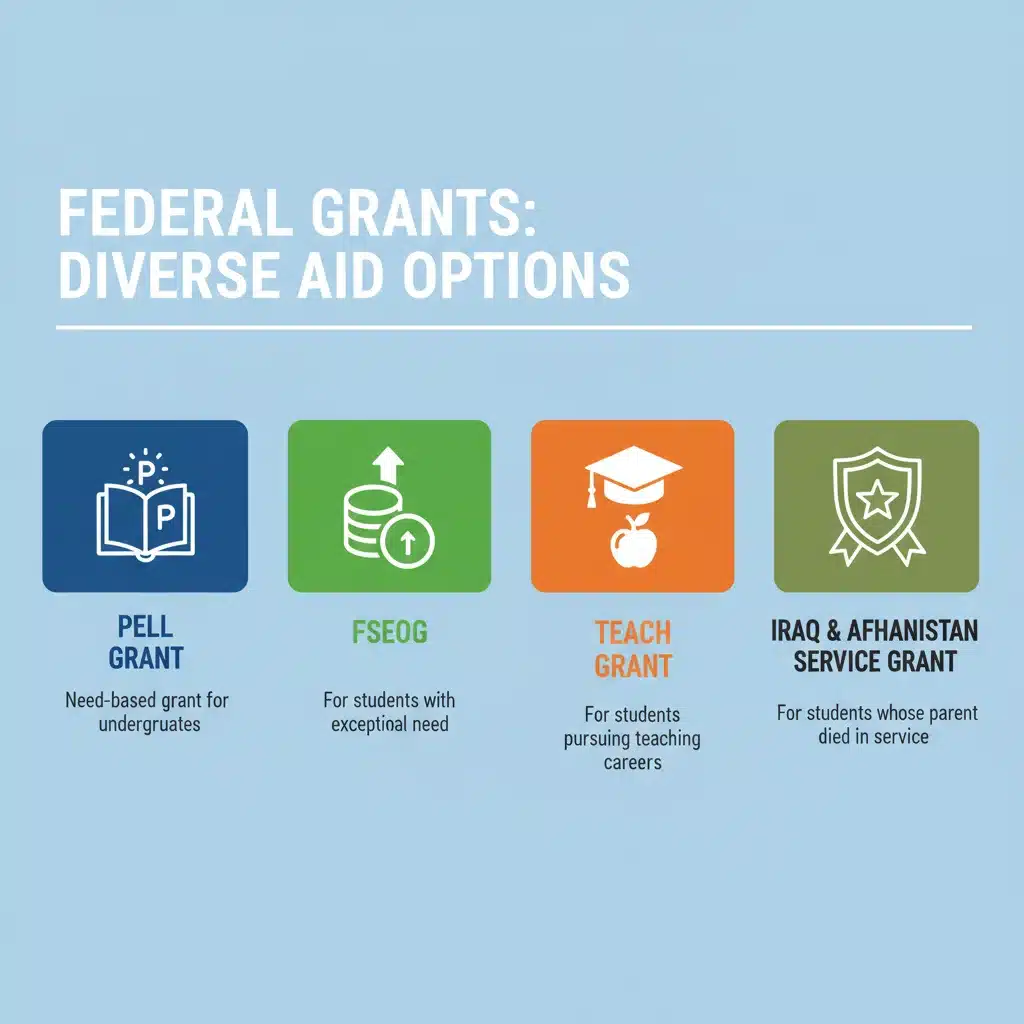
The U.S. Department of Education offers several types of Federal Student Grants, each with its own specific eligibility requirements and funding amounts. Familiarizing yourself with these different grants will help you understand which ones you might qualify for. The most common and widely sought-after federal grants include:
- Pell Grants: The cornerstone of federal student aid, Pell Grants are awarded to undergraduate students who display exceptional financial need and have not earned a bachelor’s, graduate, or professional degree. The maximum Pell Grant award can change yearly; for the 2024-2025 award year, while specific figures are subject to final appropriations, it’s anticipated to be substantial, making it a critical source of funding for many.
- Federal Supplemental Educational Opportunity Grants (FSEOG): These grants are for undergraduate students with exceptional financial need, meaning students with the lowest Expected Family Contribution (EFC) or Student Aid Index (SAI) as determined by the FAFSA. FSEOG funds are limited and are awarded directly by the financial aid office at participating schools.
- Teacher Education Assistance for College and Higher Education (TEACH) Grants: Unlike Pell or FSEOG, TEACH Grants come with a service obligation. They provide up to $4,000 per year to students who are completing or plan to complete coursework to begin a career in teaching and agree to teach for at least four years in a high-need field at an elementary school, secondary school, or educational service agency that serves low-income students. If the service obligation is not met, the grant converts into a loan with accrued interest.
- Iraq and Afghanistan Service Grants: These grants are for students who are not eligible for a Pell Grant based on their EFC/SAI but whose parent or guardian died as a result of military service in Iraq or Afghanistan after September 11, 2001, and who were under 24 years old or enrolled at least part-time in college at the time of the parent’s or guardian’s death.
Understanding the nuances of each of these Federal Student Grants is crucial for maximizing your financial aid potential. Each grant serves a different purpose and targets specific student populations, ensuring that a wide range of educational needs can be met.
The Cornerstone of Application: The FAFSA for 2024-2025
The single most important step in applying for any Federal Student Grants, and indeed most federal and state financial aid, is completing the Free Application for Federal Student Aid (FAFSA). The FAFSA collects information about your financial situation to determine your eligibility for various aid programs. For the 2024-2025 academic year, significant changes have been implemented to the FAFSA process, making it simpler but also requiring close attention to the new details.
Key Changes to the FAFSA for 2024-2025
The FAFSA Simplification Act has brought about several important revisions:
- Simplified Form: The number of questions has been significantly reduced, making the application process quicker and less intimidating.
- Student Aid Index (SAI): The Expected Family Contribution (EFC) has been replaced by the Student Aid Index (SAI). The SAI is a new eligibility index that determines federal student aid. It aims to be a more accurate measure of a student’s financial need.
- Direct Data Exchange with IRS: The FAFSA will now directly import federal tax information from the IRS using the Future Act Direct Data Exchange (FA-DDX), formerly the IRS Data Retrieval Tool. This streamlines the process and reduces errors, but requires consent from all contributors (student, parent(s), spouse, as applicable).
- Expanded Eligibility: The new FAFSA aims to expand Pell Grant eligibility to more students, particularly those from low-income backgrounds.
- Contributor Definition: The definition of ‘contributor’ has been clarified, referring to anyone required to provide information on the FAFSA (student, student’s spouse, biological or adoptive parent, or parent’s spouse).
These changes are designed to make applying for Federal Student Grants more accessible and equitable. However, it’s essential to understand these updates to ensure a smooth application process.

Step-by-Step FAFSA Application Process for 2024-2025
Here’s a detailed guide to completing your FAFSA for the 2024-2025 academic year:
Step 1: Create an FSA ID
Both the student and at least one parent (if you are a dependent student) will need an FSA ID. This is a username and password used to log in to federal student aid websites, sign the FAFSA electronically, and access your federal student aid information. Create yours at studentaid.gov.
Step 2: Gather Required Documents
Even with the simplified FAFSA, you’ll need certain documents on hand:
- Your Social Security number (and parent’s, if applicable).
- Your Alien Registration Number (if you are not a U.S. citizen).
- Federal income tax returns for the relevant tax year (for 2024-2025, you’ll use 2022 tax information).
- Records of other income earned (W-2 forms, other income records).
- Bank statements and records of investments (if applicable).
- Records of untaxed income (e.g., child support received, veterans’ noneducation benefits).
Step 3: Complete the FAFSA Online
Go to studentaid.gov and select ‘Start New FAFSA’. You will need to provide consent for the FA-DDX to retrieve your tax information directly from the IRS. This is a mandatory step for all contributors. Without consent, you will not be eligible for federal financial aid, including Federal Student Grants.
Step 4: List Schools You Are Considering
Include all colleges or career schools you are interested in. Each school you list will receive your FAFSA information, allowing them to create a financial aid package for you. You can add up to 20 schools at a time. It’s advisable to list any school you’re even remotely considering.
Step 5: Review and Submit
Carefully review all the information you’ve entered for accuracy. Once satisfied, both the student and all required contributors (e.g., a parent) must sign the FAFSA using their FSA ID. After submission, you will receive a confirmation email.
Step 6: Receive Your FAFSA Submission Summary
Within a few days to weeks of submission, you’ll receive a FAFSA Submission Summary (FSS) – the replacement for the Student Aid Report (SAR). This document summarizes the information you reported on your FAFSA and shows your calculated Student Aid Index (SAI). Review it carefully for any errors.
Important FAFSA Deadlines
While the federal deadline for the 2024-2025 FAFSA is typically June 30, 2025, it is crucial to remember that individual states and colleges often have much earlier deadlines. Many schools award financial aid on a first-come, first-served basis, especially for limited funds like FSEOG. Therefore, completing your FAFSA as soon as it becomes available (usually October 1st of the preceding year, but for 2024-2025, there was a delay, so check the official studentaid.gov website for the exact launch date) is highly recommended. Early submission significantly increases your chances of securing Federal Student Grants.
Eligibility Requirements for Federal Student Grants
Beyond filling out the FAFSA, there are several general eligibility criteria you must meet to qualify for Federal Student Grants:
- Demonstrate Financial Need: This is the primary criterion for most grants, determined by your FAFSA information and the resulting Student Aid Index (SAI).
- Be a U.S. Citizen or Eligible Non-Citizen: This includes U.S. nationals and permanent residents.
- Have a Valid Social Security Number: With some exceptions for students from the Republic of the Marshall Islands, Federated States of Micronesia, or the Republic of Palau.
- Be Enrolled in an Eligible Degree or Certificate Program: Your program must be at an eligible institution (e.g., a college, university, or career school) that participates in federal student aid programs.
- Maintain Satisfactory Academic Progress (SAP): Your school’s financial aid office will monitor your academic performance (GPA, completion rate) to ensure you are progressing toward a degree or certificate. Failure to meet SAP can result in loss of federal aid eligibility.
- Sign Statements on the FAFSA: You must certify that you will use federal student aid only for educational purposes, and that you are not in default on any federal student loans or owe a refund on a federal grant.
- Selective Service Registration (for males): If you are a male between the ages of 18 and 25, you must be registered with the Selective Service System.
Each type of Federal Student Grant may also have additional specific requirements, as outlined in the previous section. Always review the detailed criteria for each grant you are interested in.
Maximizing Your Chances of Receiving Federal Student Grants
Securing Federal Student Grants can be a competitive process, especially for limited funds. Here are strategies to maximize your chances:
1. Apply Early, Every Year
As mentioned, submitting your FAFSA as soon as it becomes available is paramount. Many schools have limited funds for certain grants (like FSEOG), and these are often disbursed on a first-come, first-served basis. Don’t wait until the last minute!
2. Be Accurate and Honest on Your FAFSA
Providing accurate information is critical. Errors can delay your application or even lead to disqualification. Be truthful about your financial situation. The FA-DDX will help verify income information directly with the IRS, reducing errors but also making it easier to detect discrepancies.
3. Understand Your Student Aid Index (SAI)
Your SAI is a key indicator of your financial need. While you can’t directly change it after submitting your FAFSA, understanding how it’s calculated can help you plan. If your financial situation changes significantly after you’ve submitted your FAFSA (e.g., job loss, medical expenses), contact your school’s financial aid office. They may be able to make a professional judgment review of your circumstances.
4. Research School-Specific Aid
While this guide focuses on Federal Student Grants, remember that many colleges offer their own institutional grants and scholarships. These often require separate applications. Research the financial aid pages of each school you apply to for additional opportunities.
5. Maintain Good Academic Standing
To continue receiving federal financial aid, including grants, you must meet your school’s Satisfactory Academic Progress (SAP) requirements. This typically involves maintaining a minimum GPA and completing a certain percentage of your attempted coursework. Falling behind academically can jeopardize your funding.
6. Consider All Options
Don’t limit your search to just federal grants. Explore state grants, scholarships from private organizations, and institutional aid. A combination of different aid types can significantly reduce your out-of-pocket costs.
What Happens After FAFSA Submission? The Award Letter
After you submit your FAFSA and it’s processed, the schools you listed will send you a financial aid offer or award letter. This letter will detail the types and amounts of financial aid you’re eligible for, which may include Federal Student Grants, state grants, institutional grants, scholarships, and federal student loans. Carefully review each offer, comparing them across different schools if you’ve applied to multiple institutions.
Understanding Your Award Letter
- Grant Amounts: Pay close attention to the grant amounts. These are the funds you typically don’t have to repay.
- Loan Offers: Differentiate clearly between grants and loans. Loans must be repaid with interest. You are not obligated to accept all loans offered.
- Work-Study: Some offers may include Federal Work-Study, which allows you to earn money through part-time employment to help pay for educational expenses.
- Cost of Attendance (COA): The award letter will usually outline the school’s estimated Cost of Attendance (tuition, fees, room, board, books, personal expenses). Ensure the aid package covers a significant portion, if not all, of this cost.
If you have questions about your award letter or believe there’s been a mistake, contact the financial aid office at the respective school immediately. They are there to help you understand your options and clarify any confusion.
Common Pitfalls to Avoid When Applying for Federal Student Grants
While the process for obtaining Federal Student Grants has been streamlined, certain mistakes can still hinder your application. Being aware of these pitfalls can save you time and stress:
- Missing Deadlines: This is arguably the biggest mistake. State and institutional deadlines are often much earlier than the federal deadline. Mark them on your calendar!
- Not Completing the FAFSA: Even if you think your family’s income is too high, you might still qualify for some aid, or it might be a prerequisite for other forms of financial assistance. Always complete it.
- Incorrect or Incomplete Information: Errors can cause significant delays. Double-check all figures and personal details. The FA-DDX helps, but you still need to ensure other information is correct.
- Forgetting to Reapply Annually: Federal Student Grants are not automatically renewed. You must complete a new FAFSA every year you wish to receive aid.
- Not Consenting to FA-DDX: Forgetting or refusing to provide consent for the direct data exchange with the IRS will make you ineligible for federal student aid. This is a mandatory step for all contributors.
- Not Following Up: Check your email and student portal regularly for updates or requests for additional information from your school’s financial aid office.
- Ignoring Your School’s Financial Aid Office: These professionals are your best resource for navigating the aid process. Don’t hesitate to reach out with questions.
Beyond Federal Student Grants: Other Funding Avenues
Even with substantial Federal Student Grants, you might find that you need additional funding to cover the full cost of your education. It’s wise to explore other options:
State Grants
Many states offer their own grant programs for residents attending in-state colleges. These often have separate application processes and deadlines, though some may use your FAFSA information. Check your state’s higher education agency website for details.
Scholarships
Scholarships are another form of gift aid that does not need to be repaid. They can be awarded based on academic merit, specific talents, ethnicity, field of study, community service, or even unique hobbies. Numerous scholarship search engines and resources are available:
- College Board Scholarship Search: A vast database of scholarships.
- Fastweb: Matches students to scholarships based on their profile.
- Niche: Offers various scholarships and search tools.
- Your High School Guidance Counselor or College Financial Aid Office: Often have information on local and institutional scholarships.
- Community Organizations and Employers: Many local organizations, foundations, and even employers offer scholarships.
Institutional Grants and Scholarships
Colleges and universities often have their own endowments and funding specifically for their students. These can be need-based or merit-based. Always check with the financial aid office of each school you apply to for their specific institutional aid opportunities.
Federal Student Loans (Last Resort)
If grants and scholarships don’t cover all your expenses, federal student loans can be a more favorable option than private loans. They often have lower interest rates, more flexible repayment plans, and don’t require a credit check for most undergraduate students. However, remember that these must be repaid.
The Long-Term Impact of Federal Student Grants
The impact of securing Federal Student Grants extends far beyond merely covering tuition costs. By reducing or eliminating the need for student loans, grants provide students with a significantly better financial footing upon graduation. This can lead to:
- Reduced Debt Burden: Graduates can start their careers without the immediate pressure of loan repayments, allowing them to save for a home, invest, or pursue further education.
- Greater Career Flexibility: Without significant debt, graduates may have more freedom to choose careers in public service, non-profits, or entrepreneurship, fields that might offer lower starting salaries but align better with their passions.
- Financial Stability: Less debt translates to greater overall financial stability and reduced stress, contributing to better mental health and well-being.
- Increased Access to Education: Grants empower individuals from all backgrounds to access quality higher education, fostering social mobility and economic growth.
In essence, Federal Student Grants are not just about paying for college; they are an investment in your future and a catalyst for broader societal progress. They represent a commitment from the government to support educational attainment and ensure that financial constraints do not derail academic potential.
Conclusion: Your Path to Funded Education with Federal Student Grants
Navigating the world of financial aid, particularly Federal Student Grants, can initially seem complex. However, by understanding the types of grants available, diligently completing the FAFSA with the new 2024-2025 changes in mind, and being proactive in your search, you can significantly reduce the financial burden of higher education. Remember that these grants are a gift, a powerful resource designed to help you achieve your academic and professional dreams without the heavy weight of debt.
Start early, be thorough, and don’t hesitate to seek assistance from your school’s financial aid office. Your persistence in understanding and applying for Federal Student Grants will pay dividends, opening doors to educational opportunities that might otherwise remain closed. The 2024-2025 academic year is an opportunity for you to invest in yourself, and federal grants are here to help make that investment possible. Take the first step today and pave your way to a brighter, debt-reduced future.