Real Estate Market Outlook 2025: Investment Opportunities Amidst Shifting Rates

The 2025 real estate market outlook presents a complex yet opportunity-rich environment for investors, characterized by evolving interest rate policies and fluctuating housing supply dynamics requiring strategic adaptation.
As we approach 2025, the real estate market outlook 2025 is poised for significant shifts, presenting both challenges and compelling investment opportunities. Understanding the interplay of interest rates, housing supply, and economic indicators is crucial for anyone looking to navigate this evolving landscape successfully.
Understanding interest rate trajectories and their market impact
Interest rates are a primary driver of real estate market activity. Their trajectory in 2025 will significantly influence affordability, buyer demand, and ultimately, property values. Predicting these movements requires a keen eye on economic indicators and central bank policies.
The Federal Reserve’s approach to inflation control will largely dictate mortgage rates. Should inflation cool, we might see more stable or even slightly declining rates, making homeownership more accessible. Conversely, persistent inflation could lead to continued rate hikes, tempering buyer enthusiasm.
The ripple effect on housing affordability
Changes in interest rates directly impact monthly mortgage payments, which in turn affect housing affordability. Even small percentage point shifts can translate into hundreds of dollars difference in monthly costs, influencing what buyers can afford and where they choose to live.
- Higher rates increase borrowing costs, reducing purchasing power.
- Lower rates can stimulate demand by making mortgages more affordable.
- Fluctuating rates create uncertainty, potentially causing buyers to delay decisions.
- Adjustable-rate mortgages (ARMs) become riskier in a rising rate environment.
Investors must consider how these affordability shifts will influence demand in various market segments. For instance, entry-level homes are often more sensitive to interest rate changes than luxury properties.
In conclusion, closely monitoring interest rate forecasts and their potential impact on mortgage rates is paramount for investors. These rates will determine the financial feasibility for many prospective buyers, shaping the overall demand and pricing strategies in the real estate market.
Analyzing housing supply and demand dynamics
The balance between housing supply and demand is another critical factor shaping the 2025 real estate market. A persistent shortage of homes, coupled with ongoing demand, has been a hallmark of recent years. Understanding if and how this imbalance will shift is key to identifying future investment hotbeds.
Construction rates, demographic trends, and migration patterns all contribute to the supply-demand equation. While new construction has picked up in some areas, it often struggles to keep pace with population growth and household formation, especially in desirable urban and suburban locales.
Regional variations in housing inventory
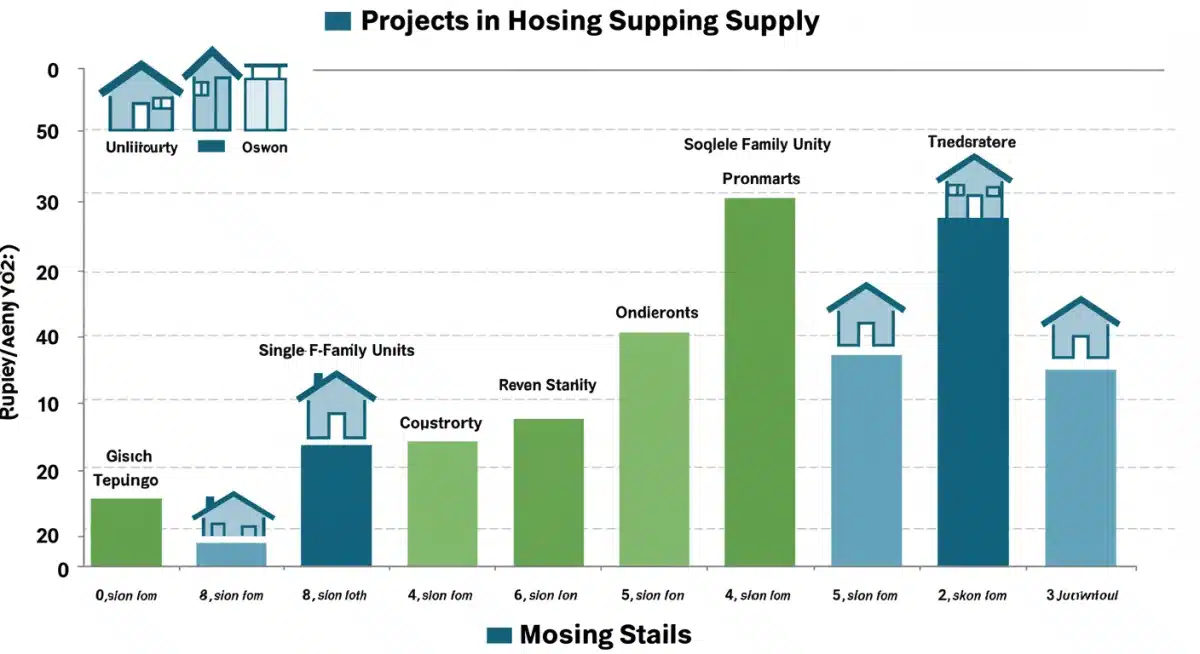
The housing supply crisis is not uniform across the United States. Some regions, particularly those with strong job growth and limited land availability, face severe shortages. Others, experiencing slower economic growth or out-migration, might see a more balanced market or even an oversupply in certain segments.
- Sun Belt cities continue to experience robust demand and supply challenges.
- Midwestern markets might offer more stability and affordability.
- Coastal urban centers often have inherent supply constraints due to geography and regulation.
- Remote work trends continue to influence demand in secondary markets.
Investors should conduct thorough regional analysis to identify areas where supply is likely to remain constrained, thereby supporting property value appreciation. Conversely, areas with increasing supply and stagnant demand could present risks.
Ultimately, the interplay of housing supply and buyer demand will dictate market competitiveness and price trajectories in 2025. A careful assessment of these dynamics at a local level is indispensable for making informed investment decisions.
Emerging investment opportunities in a dynamic market
Despite the complexities, the 2025 real estate market is ripe with emerging investment opportunities for those who can adapt. Diversification and a focus on specific market niches will be crucial. Investors should look beyond traditional single-family homes to explore other avenues.
The demand for flexible living spaces, sustainable properties, and affordable housing solutions continues to grow. These trends create unique entry points for investors willing to innovate and meet evolving consumer needs.
Key sectors poised for growth
Several real estate sectors are anticipated to outperform in the coming year, driven by demographic shifts and economic factors. Understanding these areas can help investors strategically allocate capital.
- Build-to-Rent Communities: Strong demand for rental housing, especially among younger demographics and those priced out of homeownership.
- Affordable Housing: Persistent need for housing solutions that cater to lower and middle-income individuals, often supported by government incentives.
- Sustainable and Green Properties: Growing preference for energy-efficient homes and buildings, attracting environmentally conscious tenants and buyers.
- Industrial and Logistics: Continued growth of e-commerce fuels demand for warehouses and distribution centers.
These sectors offer resilience against potential market downturns and align with long-term societal and economic trends. Identifying properties that fit these criteria, even in competitive markets, can yield substantial returns.
In summary, the dynamic nature of the 2025 real estate market necessitates a proactive approach to identifying investment opportunities. Focusing on niche markets and sectors with strong underlying demand can lead to profitable ventures.
Navigating potential risks and challenges
While opportunities abound, the 2025 real estate market also presents its share of risks and challenges. Investors must be prepared to mitigate these factors to protect their capital and ensure sustainable growth. Economic volatility, regulatory changes, and unforeseen global events can all impact the market.
Overleveraging, neglecting due diligence, and failing to account for market shifts are common pitfalls. A conservative approach to financing and a deep understanding of local market conditions are essential for risk management.
Economic headwinds and regulatory shifts
The broader economic environment will play a significant role in shaping real estate performance. A potential economic slowdown, coupled with persistent inflation, could dampen consumer confidence and reduce transaction volumes. Additionally, evolving housing policies and zoning regulations can create hurdles for development and investment.
- Inflationary Pressures: Higher construction costs and operational expenses can erode profit margins.
- Recessionary Fears: Economic downturns typically lead to reduced demand and potential price corrections.
- Local Zoning Changes: Restrictions on development or density can impact property values and potential for expansion.
- Property Tax Increases: Rising taxes can diminish rental yields and increase ownership costs.
Vigilance regarding these economic and regulatory factors is crucial. Investors should stay informed about legislative developments at both federal and local levels, as these can profoundly influence investment viability.
To conclude, successful navigation of the 2025 real estate market requires a clear understanding of potential risks. Proactive risk management, including thorough market research and a diversified portfolio, is vital for long-term success.
Strategic approaches for investors in 2025
Given the anticipated market conditions, adopting strategic approaches will be paramount for investors in 2025. This involves a blend of careful planning, market adaptability, and a willingness to explore innovative solutions. Simply relying on past strategies may not yield optimal results.
Focusing on value-add opportunities, leveraging technology, and building strong professional networks are just a few ways investors can position themselves for success. The market favors informed and agile participants.
Diversification and long-term vision
Diversifying investment portfolios across different property types and geographical locations can mitigate risk and enhance returns. A long-term perspective, rather than chasing short-term gains, often proves more resilient in fluctuating markets.
- Geographic Diversification: Invest in multiple regions to spread risk and capitalize on localized growth.
- Property Type Diversification: Blend single-family, multi-family, commercial, and industrial assets.
- Value-Add Strategies: Acquire properties that can be improved or repositioned to increase their value.
- Data-Driven Decisions: Utilize market analytics and economic forecasts to inform investment choices.
Furthermore, understanding the demographics of target tenants or buyers can help tailor investment strategies more effectively. For example, investing in areas with growing populations of young professionals might favor rental properties or smaller, more modern homes.
In essence, a strategic approach for 2025 involves thoughtful diversification and a commitment to long-term growth. Adapting to market signals and continuously refining investment strategies will be key to thriving in this dynamic environment.
The role of technology and data in real estate investment
In the 2025 real estate market, technology and data analytics are no longer just tools but essential components of a successful investment strategy. Leveraging these resources can provide investors with a significant competitive edge, enabling more informed decisions and efficient operations.
From predictive analytics to virtual tours and blockchain-powered transactions, technology is transforming how properties are identified, evaluated, and managed. Investors who embrace these advancements will be better positioned to capitalize on market opportunities.
Enhancing decision-making with advanced analytics
Advanced data analytics can uncover trends and insights that might otherwise be missed. This includes identifying undervalued properties, forecasting market shifts, and optimizing rental pricing. AI and machine learning are making these capabilities more accessible to individual investors.
- Predictive Modeling: Forecast future property values and rental income based on various economic indicators.
- Market Scanning Tools: Rapidly identify properties that meet specific investment criteria across vast databases.
- Automated Valuation Models (AVMs): Provide instant property valuations, speeding up due diligence processes.
- Geospatial Analysis: Understand demographic shifts, infrastructure development, and neighborhood changes.
Beyond acquisition, technology also streamlines property management, tenant screening, and maintenance, leading to greater operational efficiency and reduced costs. Smart home technology, for instance, can enhance property appeal and command higher rents.
To summarize, technology and data are indispensable for real estate investors in 2025. Integrating these tools into every aspect of the investment process can lead to smarter decisions, optimized portfolios, and superior returns.
| Key Point | Brief Description |
|---|---|
| Interest Rates | Fluctuations will heavily influence affordability and buyer demand in 2025. |
| Housing Supply | Regional imbalances persist, creating varied opportunities and challenges. |
| Investment Niches | Build-to-rent, affordable housing, and sustainable properties offer growth. |
| Technology Use | Data analytics and AI are crucial for informed decision-making and efficiency. |
Frequently asked questions about the 2025 real estate market
Interest rate changes in 2025 will directly influence home prices by affecting buyer affordability. Higher rates typically cool demand and can lead to price stabilization or modest declines, while lower rates tend to boost demand and support price growth. The precise impact will vary by local market conditions.
In 2025, promising investment opportunities include build-to-rent communities, affordable housing developments, and properties focused on sustainability or energy efficiency. Industrial and logistics real estate also remains strong due to continued e-commerce growth. Diversification across these sectors is advised.
Yes, the housing supply shortage is expected to persist in many U.S. regions into 2025, though with some variation. New construction is increasing but often struggles to keep pace with demand, especially in high-growth areas. Local market analysis is crucial to understand specific supply dynamics.
Technology in 2025 offers investors advanced data analytics for market forecasting, automated valuation models, and efficient property management tools. These resources enhance decision-making, identify undervalued assets, and streamline operations, providing a competitive edge in a complex market.
Key risks for real estate investors in 2025 include potential economic slowdowns, persistent inflation impacting construction and operational costs, and evolving regulatory landscapes such as zoning changes or increased property taxes. Overleveraging and insufficient market research are also significant pitfalls.
Conclusion
The real estate market outlook 2025 presents a complex yet navigable environment for investors. Success hinges on a deep understanding of interest rate trajectories, housing supply dynamics, and emerging market niches. By embracing data-driven strategies, diversifying portfolios, and carefully mitigating risks, investors can uncover significant opportunities amidst the shifting landscape. The key is to remain informed, adaptable, and forward-thinking to capitalize on the evolving demands of the American housing market.