Investment Strategies for a Volatile 2025: Diversifying for Growth

Effective volatile market investment strategies for 2025 demand careful diversification into targeted growth sectors to achieve a resilient portfolio aiming for 10% returns amidst economic uncertainty.
As we look towards 2025, the investment landscape promises continued volatility, presenting both challenges and unparalleled opportunities for the astute investor. Crafting robust Investment Strategies for a Volatile 2025: Diversifying Your Portfolio with a Focus on 10% Growth Sectors is not merely advisable, but essential. This guide will explore how strategic diversification can shield your assets while pinpointing sectors primed for significant returns, helping you navigate the complexities of an evolving global economy.
understanding the 2025 market landscape
The year 2025 is projected to be characterized by a confluence of economic forces, including persistent inflation concerns, evolving geopolitical tensions, and rapid technological advancements. These factors collectively contribute to a market environment where traditional investment approaches may prove insufficient. Investors must prepare for dynamic shifts and possess the agility to adapt their portfolios.
Understanding the macro-economic picture is the first step in formulating effective strategies. Interest rate policies from central banks globally will continue to play a pivotal role, impacting everything from corporate borrowing costs to consumer spending habits. Furthermore, supply chain resilience, or lack thereof, will still influence manufacturing and retail sectors, often creating unexpected bottlenecks or opportunities.
geopolitical influences on investment
Geopolitical events, such as trade disputes or regional conflicts, have a direct and often immediate impact on investor sentiment and market stability. These events can trigger sudden shifts in commodity prices, currency valuations, and even the viability of international business operations. A keen awareness of global political dynamics is crucial for anticipating market reactions.
- Trade Policies: Changes in trade agreements can affect import/export businesses and their profitability.
- Regional Conflicts: Instability can disrupt supply chains and increase energy costs.
- Cybersecurity Threats: Growing concerns can lead to increased investment in defensive technologies.
In summary, the 2025 market landscape is a complex tapestry woven with economic indicators, technological breakthroughs, and geopolitical undercurrents. A thorough understanding of these elements is foundational for any investor aiming to achieve a 10% growth target through strategic diversification and proactive risk management.
the power of diversification in volatile times
Diversification is often lauded as the only free lunch in finance, and its importance intensifies during periods of market volatility. Spreading investments across various asset classes, industries, and geographic regions helps to mitigate risk by ensuring that a downturn in one area does not decimate an entire portfolio. For 2025, this principle becomes paramount, moving beyond mere asset allocation to strategic, targeted diversification.
True diversification involves more than just owning a mix of stocks and bonds. It encompasses exploring alternative investments, considering different market capitalizations, and even international exposure. The goal is to create a portfolio where assets react differently to market events, balancing potential losses with gains in other areas. This approach is key to maintaining stability and pursuing growth objectives.
beyond traditional asset classes
While stocks and bonds form the bedrock of many portfolios, looking beyond these traditional categories is vital for robust diversification in 2025. Alternative investments, such as real estate, private equity, and even certain commodities, can offer uncorrelated returns, providing a hedge against market downturns in public equities.
- Real Estate: Offers potential for income and capital appreciation, often with lower correlation to public markets.
- Private Equity: Access to high-growth private companies, though with higher illiquidity.
- Commodities: Can act as an inflation hedge and perform well during specific economic cycles.
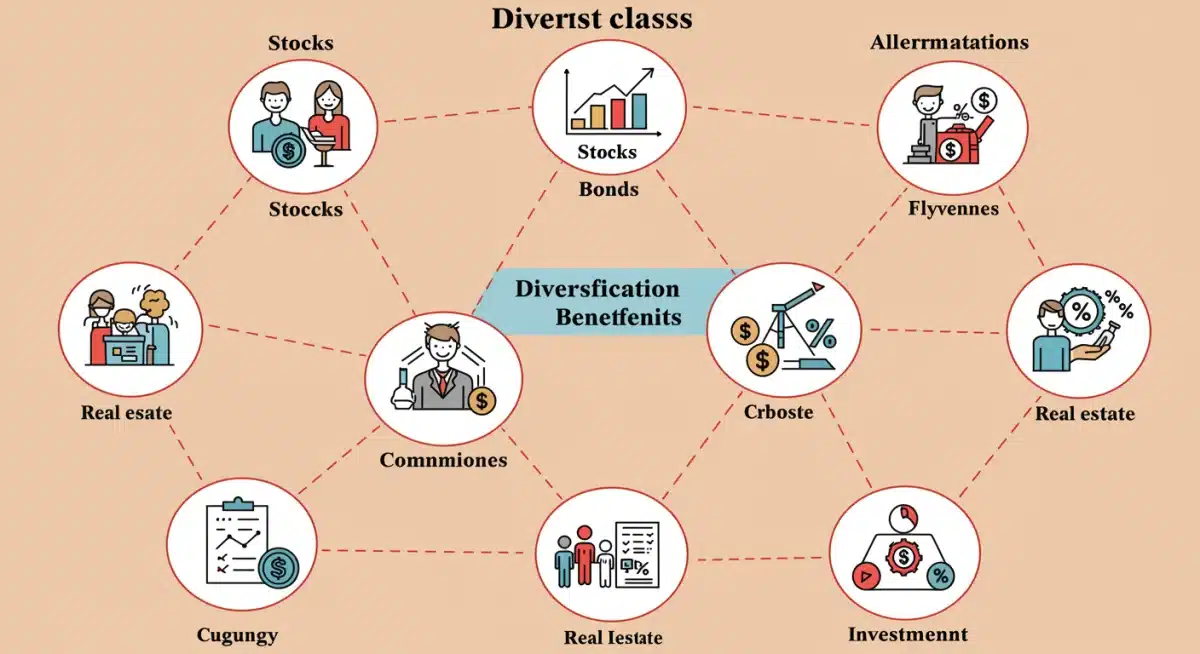
Effective diversification in a volatile 2025 market is about building a resilient portfolio that can weather storms while still capturing upside potential. By thoughtfully allocating capital across a broad spectrum of asset types, investors can reduce overall risk and enhance their probability of achieving consistent, targeted returns, even when market conditions are unpredictable.
identifying 10% growth sectors for 2025
Achieving a 10% growth target in 2025 requires a keen eye for sectors poised for significant expansion, irrespective of broader market movements. These are typically industries driven by innovation, demographic shifts, or fundamental economic needs that continue to grow even in challenging environments. Identifying these sectors early is crucial for positioning a portfolio for success.
The rapid pace of technological development remains a primary driver of growth across multiple industries. Digital transformation, artificial intelligence, and sustainable technologies are not just buzzwords; they represent foundational shifts creating new markets and expanding existing ones. Investors should look for companies at the forefront of these innovations.
technology and artificial intelligence
The AI revolution is still in its nascent stages, yet its impact is already profound. Companies developing AI algorithms, machine learning platforms, and specialized hardware are experiencing exponential growth. Beyond direct AI companies, businesses leveraging AI to optimize operations, enhance customer experience, or create new products will also see significant advantages.
- AI Software Development: Companies creating scalable AI applications.
- Semiconductor Manufacturing: Essential for powering AI infrastructure.
- Data Analytics: Businesses specializing in processing and interpreting large datasets for AI.
Another sector showing immense promise is renewable energy. The global push towards decarbonization is creating unprecedented demand for solar, wind, geothermal, and other clean energy solutions. Investment in infrastructure, storage technologies, and smart grid solutions within this sector is expected to deliver strong returns.
In conclusion, pinpointing sectors with intrinsic growth drivers is fundamental to hitting a 10% growth target in 2025. Technology, particularly AI, and renewable energy stand out as prime candidates, offering fertile ground for investors willing to delve into their underlying innovations and market potential.
healthcare innovation and biotechnology
The healthcare sector, particularly its innovative sub-segments like biotechnology and personalized medicine, is another area ripe for substantial growth in 2025. Driven by an aging global population, increasing awareness of health and wellness, and continuous scientific breakthroughs, demand for advanced medical solutions remains robust, often detached from broader economic cycles.
Biotechnology companies are at the forefront of developing new therapies, vaccines, and diagnostic tools. Their research and development efforts, though high-risk, offer the potential for significant rewards when successful. Advances in gene editing, immunotherapy, and mRNA technology are transforming patient care and creating entirely new markets.
personalized medicine and telehealth
Personalized medicine, which tailors medical treatment to the individual characteristics of each patient, is gaining traction. This approach leverages genetic information and lifestyle data to provide more effective and targeted care. Companies involved in genomic sequencing, pharmacogenomics, and precision diagnostics are set for significant expansion.
- Genomic Sequencing: Technologies that map an individual’s DNA for tailored treatments.
- Biopharmaceutical Research: Development of targeted drugs based on genetic profiles.
- Telehealth Platforms: Expanding access to healthcare services through digital means.
Telehealth services, which saw an explosion in adoption during recent global health crises, are expected to continue their growth trajectory. The convenience and accessibility offered by virtual consultations and remote patient monitoring are driving sustained demand, leading to continued investment in supporting technologies and platforms.
Ultimately, the healthcare and biotechnology sectors demonstrate resilience and inherent growth potential, making them attractive for investors seeking a 10% return in 2025. Their focus on addressing fundamental human needs and their capacity for groundbreaking innovation position them as strong pillars within a diversified portfolio.
sustainable and green technologies
The global imperative to address climate change is fueling unprecedented investment in sustainable and green technologies, making this sector a prime candidate for achieving 10% growth in 2025. This encompasses a broad range of innovations, from renewable energy generation and energy storage to sustainable agriculture and waste management solutions. Governments, corporations, and consumers are increasingly prioritizing environmentally friendly practices, creating a powerful tailwind for these industries.
Beyond just renewable energy sources, the entire ecosystem supporting a greener economy is expanding. This includes companies developing efficient battery storage solutions, electric vehicle infrastructure, smart grid technologies, and even sustainable materials. The transition to a low-carbon economy is a multi-decade trend, ensuring sustained growth for innovators in this space.
circular economy and resource efficiency
The concept of a circular economy, which aims to eliminate waste and pollution, circulate products and materials, and regenerate nature, is driving innovation in resource efficiency. Companies focused on recycling technologies, upcycling, and designing products for longevity and reuse are becoming increasingly vital.
- Waste-to-Energy Solutions: Technologies converting waste into usable energy.
- Sustainable Packaging: Development of biodegradable and recyclable packaging materials.
- Water Treatment and Conservation: Innovations in purifying and conserving water resources.
Furthermore, advancements in sustainable agriculture, such as vertical farming, precision agriculture, and alternative protein production, are addressing food security challenges while minimizing environmental impact. These areas offer significant growth potential as global food systems evolve.
In essence, sustainable and green technologies are not just an ethical choice but a financially sound one for 2025. The confluence of environmental necessity, consumer demand, and policy support positions this sector as a strong contender for investors targeting robust and responsible growth.
risk management and portfolio rebalancing
Even with carefully selected growth sectors, a volatile market demands rigorous risk management and periodic portfolio rebalancing. The goal is not just to identify promising investments but to protect capital and lock in gains. For 2025, this means a proactive approach to monitoring market conditions and adjusting allocations as necessary, rather than a set-and-forget strategy.
Risk management involves understanding the specific risks associated with each investment – whether market risk, credit risk, or liquidity risk – and ensuring these are balanced across the portfolio. Stress testing your portfolio against various economic scenarios can reveal potential vulnerabilities before they become critical, allowing for preemptive adjustments.
dynamic asset allocation
Dynamic asset allocation is a strategy where portfolio weights are adjusted over time in response to changing market conditions. Unlike static approaches, it allows investors to increase exposure to sectors performing well and reduce exposure to those facing headwinds. This flexibility is crucial in a volatile 2025 environment.
- Regular Review: Schedule quarterly or bi-annual portfolio reviews to assess performance.
- Set Triggers: Define specific market events or performance metrics that prompt rebalancing.
- Diversify within sectors: Don’t put all your eggs in one basket, even within a growth sector.
Portfolio rebalancing is the process of realigning the weightings of a portfolio of assets. This involves selling investments that have performed well (and thus have become a larger percentage of the portfolio) and buying investments that have underperformed (and are now a smaller percentage). This strategy helps maintain the original asset allocation and risk profile, ensuring that the portfolio does not drift too far from its intended composition.
Ultimately, successful investing in a volatile 2025 is a continuous process of strategic selection, vigilant monitoring, and disciplined adjustment. By integrating robust risk management and dynamic rebalancing, investors can enhance their chances of achieving their 10% growth objectives while navigating market uncertainties effectively.
| Key Investment Strategy | Brief Description for 2025 |
|---|---|
| Strategic Diversification | Spread investments across varied asset classes and geographies to mitigate market volatility. |
| High-Growth Sector Focus | Target industries like AI, biotech, and green tech for potential 10% returns. |
| Proactive Risk Management | Actively monitor and adjust portfolios to protect capital and lock in gains. |
| Continuous Rebalancing | Regularly adjust asset allocations to maintain desired risk-return profile. |
frequently asked questions about 2025 investments
The 2025 market is expected to be volatile due to ongoing inflation concerns, evolving geopolitical tensions, and the rapid pace of technological change. These factors create uncertainty, requiring investors to adopt flexible and adaptive strategies to protect and grow their capital effectively.
Diversification spreads risk across various asset classes and sectors, preventing a single downturn from severely impacting the entire portfolio. By strategically allocating investments into multiple high-growth areas, such as AI and green technologies, the portfolio increases its chances of hitting a 10% growth target even if some investments underperform.
Key high-growth sectors for 2025 include Artificial Intelligence (AI), biotechnology and personalized medicine, and sustainable/green technologies. These industries are driven by innovation, demographic shifts, and global imperatives, offering significant potential for substantial returns and portfolio expansion.
Risk management is crucial because it helps identify, assess, and mitigate potential threats to your investments. In volatile markets, unexpected events can quickly erode capital. Proactive risk management, including stress testing and dynamic asset allocation, helps protect your portfolio and ensures you stay on track towards your financial goals.
The frequency of portfolio rebalancing depends on individual circumstances and market conditions, but generally, quarterly or bi-annual reviews are recommended. This ensures your asset allocation remains aligned with your risk tolerance and investment objectives, preventing the portfolio from drifting significantly due to market fluctuations.
conclusion
Navigating the anticipated volatility of the 2025 market demands more than just traditional investment approaches; it requires a strategic, diversified, and adaptive mindset. By understanding the macro-economic landscape, embracing robust diversification across asset classes, and meticulously identifying high-growth sectors such as AI, biotechnology, and green technologies, investors can position themselves not only to mitigate risks but also to achieve ambitious growth targets, potentially reaching 10%. Continuous risk management and proactive portfolio rebalancing will serve as indispensable tools, ensuring resilience and sustained performance in an ever-changing financial world. The future of investing is dynamic, and preparedness is the ultimate key to success.