Vocational Training vs. Traditional Degrees: Your 2026 Career Path Choice

Vocational Training vs. Traditional Degrees: Navigating Your Career Path in 2026
In an ever-evolving global economy, the decision of which educational path to pursue is more critical than ever. As we look towards 2026, the landscape of work continues to shift, bringing new demands and opportunities. For many, the central question revolves around choosing between vocational training and a traditional degree. Both pathways offer distinct advantages and cater to different aspirations and learning styles. Understanding the nuances of each, especially in the context of the upcoming years, is paramount for making an informed decision about your future career.
The traditional four-year university degree has long been seen as the gold standard, a gateway to professional success and upward mobility. However, vocational training programs have gained significant traction, lauded for their hands-on approach and direct route to employment in high-demand fields. This article aims to provide a comprehensive analysis of vocational training vs degrees, offering insights into their respective benefits, challenges, and suitability for various career goals in 2026.
We will delve into the evolving job market, the financial implications of each choice, the types of skills acquired, and the long-term career prospects. By examining these factors, individuals can better align their educational investments with their personal strengths and professional ambitions, ensuring a robust and fulfilling career journey.
The Evolving Job Market: What 2026 Demands
The year 2026 is projected to bring further automation, digitalization, and a heightened demand for specialized skills. Industries are rapidly transforming, and the types of jobs available are changing in tandem. This dynamic environment necessitates a fresh look at how education prepares individuals for the workforce. The debate of vocational training vs degrees becomes even more pertinent when considering these shifts.
Traditional degrees, particularly in fields like computer science, engineering, healthcare, and business analytics, continue to be highly valued for their emphasis on critical thinking, problem-solving, and theoretical knowledge. These programs often equip graduates with a broad understanding that can be applied across various sectors, fostering adaptability in a changing job market. For roles that require extensive research, strategic planning, or complex theoretical frameworks, a traditional degree often provides the foundational knowledge necessary.
Conversely, vocational training programs are perfectly positioned to address the immediate and growing need for skilled trades and technical professions. Think about fields such as renewable energy technicians, cybersecurity specialists, advanced manufacturing operators, and healthcare support staff. These roles often require very specific, hands-on competencies that vocational programs are designed to deliver efficiently. The focus here is on practical application, preparing students to step directly into a job with minimal additional training.
The gig economy and the rise of remote work also play a significant role in shaping demand. Both pathways can lead to success in these flexible work arrangements, but vocational skills can often be more directly monetized in project-based work, while traditional degrees might open doors to more complex consulting or leadership roles within remote teams.
Ultimately, 2026 demands a workforce that is not only knowledgeable but also agile and skilled. The choice between vocational training vs degrees should therefore consider not just current job openings, but also future industry trends and the longevity of the skills acquired.
Vocational Training: A Deep Dive into Practical Skills and Rapid Entry
Vocational training, often delivered through technical schools, community colleges, or apprenticeships, is characterized by its practical, hands-on approach. The primary goal is to equip students with specific skills required for a particular trade or occupation. These programs are typically shorter in duration than traditional degrees, ranging from a few months to two years, and are often more affordable.
Key Advantages of Vocational Training:
- Direct Skill Acquisition: Vocational programs focus intensely on the competencies needed for a specific job. Students spend a significant amount of time in labs, workshops, or real-world settings, gaining practical experience. For example, an aspiring electrician will spend hours wiring circuits, while a culinary student will master cooking techniques in a professional kitchen. This direct application makes vocational training highly effective for immediate job readiness.
- Faster Entry into the Workforce: Due to their shorter duration, vocational graduates can enter the job market much quicker than their university counterparts. This means earning potential begins sooner, which can be a significant financial advantage, especially for those eager to become financially independent or support families.
- Lower Cost of Education: Generally, vocational training programs have lower tuition fees compared to four-year university degrees. This reduced financial burden translates to less student debt, a critical consideration in today’s economic climate.
- High Demand for Skilled Trades: Many vocational fields, such as HVAC repair, automotive technology, plumbing, welding, and medical assisting, consistently face labor shortages. This high demand often translates into good job security and competitive wages for skilled professionals. The emphasis on vocational vs degrees in addressing these shortages is growing.
- Hands-On Learning Preference: For individuals who thrive in practical, experiential learning environments rather than theoretical, lecture-based settings, vocational training offers a more engaging and effective educational experience.
- Industry-Specific Certifications: Many vocational programs lead to industry-recognized certifications, which are powerful credentials that validate a person’s skills and often serve as direct pathways to employment.
Considerations for Vocational Training:
- Specialization vs. Breadth: While highly specialized, vocational training might offer less breadth of knowledge compared to a traditional degree. This could potentially limit career mobility into roles requiring a more diverse academic background, though many vocational fields now offer pathways for advanced specialization or even degree conversion.
- Perceived Prestige: Historically, vocational training has sometimes carried a stigma compared to university degrees. However, this perception is rapidly changing as the value of skilled trades and technical expertise becomes increasingly recognized and respected in the modern economy. The discussion of vocational vs degrees is increasingly shifting towards recognizing equal value.
- Evolving Technology: While vocational training prepares for current industry standards, the rapid pace of technological change means continuous learning and upskilling are crucial to stay relevant.
Traditional Degrees: The Path of Broad Knowledge and Long-Term Growth
Traditional degrees, typically bachelor’s, master’s, and doctoral programs offered by universities, focus on a broader curriculum that includes general education alongside specialized major coursework. The emphasis is on critical thinking, research, theoretical understanding, and often, personal development.
Key Advantages of Traditional Degrees:
- Comprehensive Knowledge Base: University education provides a wide range of knowledge across various disciplines, fostering intellectual curiosity and a holistic understanding of the world. This breadth can be invaluable for roles requiring interdisciplinary thinking or adaptability across different functions within an organization.
- Development of Soft Skills: Traditional degrees often cultivate crucial soft skills such as communication, critical thinking, analytical reasoning, research, and problem-solving through essays, presentations, and group projects. These skills are highly valued by employers across all sectors.
- Greater Career Mobility and Advancement: A bachelor’s degree can open doors to a wider array of professions, especially those in management, leadership, research, and highly specialized fields like law or medicine. It often serves as a prerequisite for advanced degrees, which are essential for certain career paths. The debate between vocational vs degrees often highlights this long-term mobility.
- Networking Opportunities: Universities offer extensive networking opportunities with professors, alumni, and peers, which can be beneficial for career development, mentorship, and future job prospects.
- Higher Earning Potential (Long-Term): While vocational graduates may start earning sooner, statistics often show that, on average, individuals with bachelor’s degrees earn more over their lifetime. This is often due to access to higher-paying professions and greater opportunities for promotion.
- Personal Growth and Exploration: University life provides a unique environment for personal growth, intellectual exploration, and exposure to diverse perspectives, contributing to a well-rounded individual.
Considerations for Traditional Degrees:
- Higher Cost and Student Debt: University tuition, fees, and living expenses can accumulate to a substantial amount, often leading to significant student loan debt. This is a primary concern for many when weighing vocational vs degrees.
- Longer Time to Entry into Workforce: A typical bachelor’s degree takes four years, meaning graduates enter the workforce later than their vocational counterparts, postponing earning potential.
- Less Direct Job Readiness: While providing a strong theoretical foundation, some traditional degree programs may not always offer the immediate, hands-on job-specific skills that vocational training does. Graduates might require additional on-the-job training or internships to fully transition into their chosen careers.
- Market Saturation in Some Fields: Certain degree fields can become saturated with graduates, leading to increased competition for entry-level positions and potentially lower starting salaries.

Vocational Training vs Degrees: Financial Implications and ROI
The financial aspect is often a deciding factor when choosing an educational path. Both vocational training and traditional degrees represent significant investments, but their returns on investment (ROI) can differ substantially, especially in the short to medium term.
Cost of Education:
Vocational programs are generally more affordable. Tuition for a certificate or associate’s degree at a technical school or community college can range from a few thousand to tens of thousands of dollars. These programs are designed to be cost-effective and often have state or federal funding options, as well as scholarships targeted at specific trades. This lower upfront cost significantly reduces the financial barrier to entry.
Traditional four-year university degrees, on the other hand, can be considerably more expensive. Tuition and fees at public universities can range from $10,000 to $40,000 per year, while private institutions can exceed $60,000 annually. When factoring in living expenses, books, and other costs, the total investment can easily reach six figures. This often necessitates taking out substantial student loans, which can impact financial freedom for years after graduation.
Time to Earning:
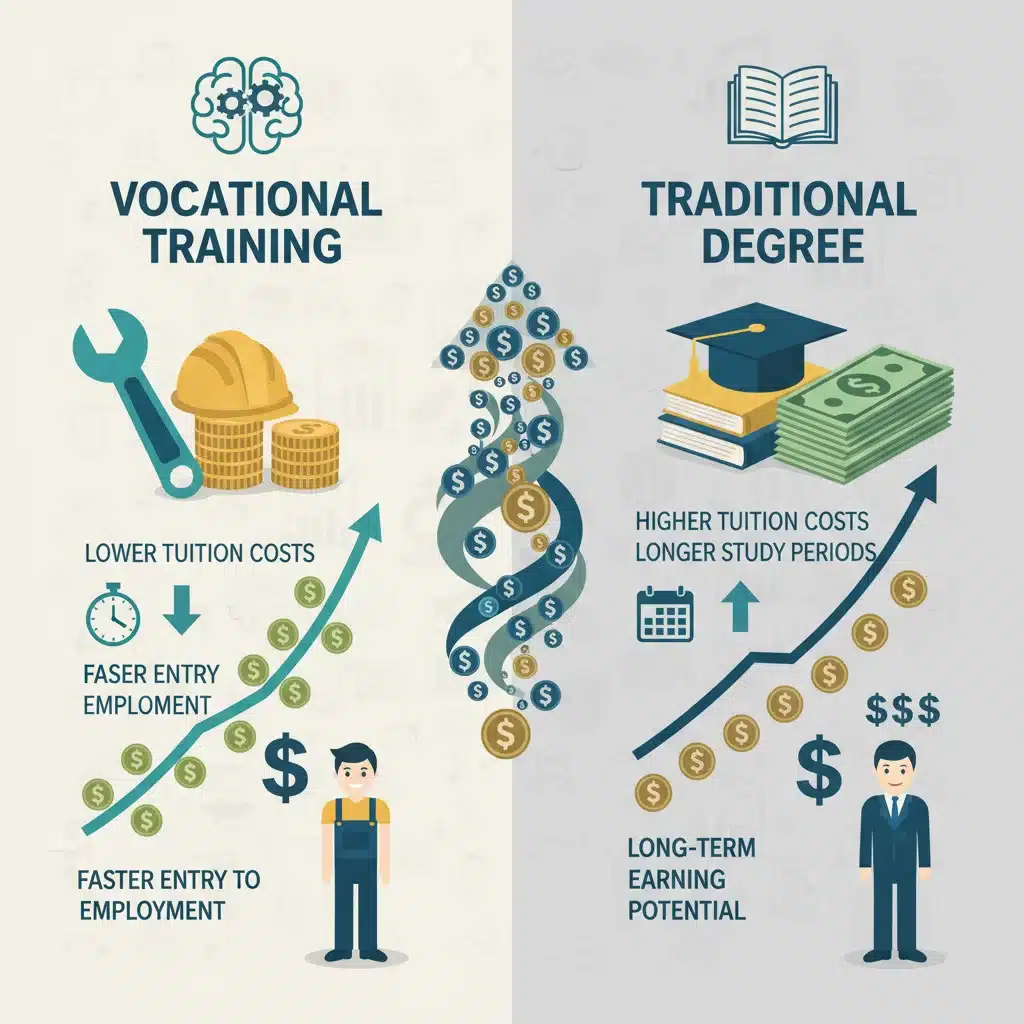
Vocational training offers a quicker path to employment and earning. Graduates can often start working in their chosen field within months to a couple of years. This means they begin accumulating work experience and earning an income much sooner, allowing them to pay off any smaller debts or save for future investments.
Traditional degree holders typically spend four years in full-time study before entering the professional workforce. While internships during their studies can provide some income and experience, full-time earning potential is delayed. This delay, coupled with higher student debt, means the break-even point for traditional degree holders can be further out.
Long-Term Earning Potential:
Historically, a bachelor’s degree has been associated with higher lifetime earnings. While this trend generally holds true, the gap is narrowing in many fields, particularly those experiencing high demand for skilled trades. Certain vocational careers, especially those requiring specialized certifications and continuous upskilling, can offer very competitive salaries, sometimes even surpassing entry-level salaries of some degree-holders.
For example, a skilled welder or an experienced IT network administrator with vocational training and certifications might earn as much, if not more, than a fresh graduate with a liberal arts degree. Moreover, the ability to start earning earlier allows vocational graduates to invest sooner, potentially compounding their wealth over time. This makes the vocational vs degrees argument more complex than a simple income comparison.
The ROI for both paths depends heavily on the chosen field, individual drive, and continuous learning. It’s crucial for prospective students to research salary expectations and job growth for specific careers within both vocational and traditional sectors before making a decision.
Choosing Your Path: Factors to Consider in 2026
The decision between vocational training vs degrees is deeply personal and should be based on a careful evaluation of several factors:
1. Your Learning Style:
- Hands-on vs. Theoretical: Do you learn best by doing, building, and fixing? Or do you prefer reading, researching, and engaging in abstract thought? Vocational training is ideal for kinesthetic learners, while traditional degrees suit those who thrive in academic, theoretical environments.
2. Career Goals and Aspirations:
- Specific Trade vs. Broad Profession: Are you passionate about a particular trade like carpentry, coding, or nursing, and eager to specialize quickly? Or do you envision a career that requires a broad understanding of a field, potentially leading to diverse roles in management, research, or academia?
- Immediate Employment vs. Long-Term Growth: Do you prioritize entering the workforce quickly and earning an income, or are you willing to invest more time and money for potentially greater long-term career mobility and higher earning potential?
3. Industry Demand and Future Outlook:
- Research Job Market Trends: Investigate which industries are growing and which skills are in high demand for 2026 and beyond. Websites like the Bureau of Labor Statistics (BLS) and industry-specific reports can provide valuable insights.
- Adaptability: Consider how easily the skills you acquire can adapt to future technological changes. Both paths require continuous learning, but the nature of that learning might differ.
4. Financial Situation and Debt Tolerance:
- Budget and Funding: Evaluate the cost of each pathway against your financial resources and willingness to take on student debt. Explore scholarships, grants, and financial aid options for both vocational training and traditional degrees.
- Return on Investment: Consider the potential ROI in terms of salary, job satisfaction, and career growth for your chosen field.
5. Personal Interests and Values:
- Passion and Fulfillment: Ultimately, choose a path that aligns with your passions and values. Job satisfaction and a sense of purpose are crucial for long-term career success and well-being.
Hybrid Approaches and Lifelong Learning
It’s important to recognize that the choice between vocational training vs degrees is not always an ‘either/or’ proposition. Increasingly, hybrid models and pathways for lifelong learning are emerging:
- Stackable Credentials: Many vocational programs offer stackable credentials, where certificates can build upon each other, eventually leading to an associate’s degree or even transferring credits towards a bachelor’s degree. This allows individuals to gain immediate employment while continuing their education.
- Apprenticeships with Academic Components: Modern apprenticeships often combine on-the-job training with classroom instruction, sometimes leading to college credits or degrees alongside professional certifications.
- Micro-credentials and Online Learning: The rise of online platforms and micro-credentials allows individuals to gain specific skills or certifications to complement either a vocational background or a traditional degree, staying relevant in a rapidly changing job market.
- Degree Holders Pursuing Vocational Skills: It’s not uncommon for individuals with traditional degrees to pursue vocational training later in their careers to acquire practical skills for a career change or to enhance their existing expertise.
The concept of lifelong learning is paramount, regardless of the initial educational choice. The most successful professionals in 2026 will be those who are committed to continuously acquiring new skills and adapting to new technologies and industry demands. The discussion of vocational vs degrees should always include this critical element of continuous development.
Conclusion: Making Your Informed Choice for 2026
The decision between vocational training vs degrees in 2026 is a significant one, with profound implications for your career trajectory, financial well-being, and personal development. There is no single ‘best’ path; rather, the optimal choice depends on your individual circumstances, aspirations, and how you envision your future in a dynamic world.
Vocational training offers a direct, cost-effective route to specialized skills and rapid entry into high-demand trades, providing immediate earning potential and hands-on expertise. It’s an excellent choice for those who thrive on practical application and have a clear career goal in a specific technical or skilled field.
Traditional degrees provide a broad educational foundation, fostering critical thinking, research skills, and opening doors to a wider array of professions, often with greater long-term career mobility and leadership opportunities. This path suits those seeking a comprehensive academic experience and who are interested in fields requiring extensive theoretical knowledge or advanced qualifications.
As you weigh vocational vs degrees, consider your learning style, financial situation, career aspirations, and the evolving demands of the 2026 job market. Remember that the educational journey doesn’t end with a degree or a certificate; lifelong learning, adaptability, and continuous skill development are key ingredients for sustained success in any profession.
By carefully evaluating these factors and potentially exploring hybrid educational models, you can make an informed decision that aligns with your strengths and sets you on a fulfilling and prosperous career path for 2026 and beyond.