New Vocational Training Programs in the U.S. for 2026: High-Demand Careers
The U.S. is rolling out new vocational training programs in 2026, strategically designed to align with the evolving demands of high-growth industries, offering pathways to secure and prosperous careers.
As the landscape of the American job market continues to evolve at an unprecedented pace, the need for skilled professionals in burgeoning sectors becomes increasingly critical. The year 2026 is poised to introduce a wave of transformative new vocational training programs in the U.S. for 2026: opportunities for high-demand careers, designed to equip the workforce with the precise skills required for these rapidly expanding industries. These initiatives are not merely about learning a trade; they represent a strategic investment in the nation’s human capital, offering individuals clear pathways to stable, well-paying jobs and fostering economic resilience across communities.
The Evolving Landscape of Vocational Education
Vocational education, once primarily associated with traditional trades, has undergone a significant transformation. Today, it stands as a dynamic and forward-thinking pathway to career success, integrating cutting-edge technology and industry-specific knowledge. The shift reflects a broader understanding that a four-year degree is not the sole route to professional fulfillment and economic stability, particularly in sectors experiencing rapid innovation and acute labor shortages.
The modern vocational training paradigm emphasizes hands-on experience, practical application, and direct alignment with employer needs. This approach ensures that graduates are not only knowledgeable but also immediately job-ready, capable of contributing effectively from day one. This evolution is crucial for maintaining the competitiveness of the U.S. economy and providing accessible opportunities for a diverse range of learners.
Redefining Career Pathways
The traditional perception of vocational training has often limited its appeal, but a new era is dawning. Programs are now being meticulously designed to address the complexities of modern industries, moving beyond manual labor to encompass highly technical and specialized fields. This redefinition broadens the scope of potential careers for students, making vocational education an attractive option for those seeking efficient and effective routes to employment.
- Focus on modern skills: Emphasizing digital literacy, automation, and data analysis.
- Industry partnerships: Collaborating with businesses to ensure curriculum relevance.
- Flexible learning models: Offering hybrid and online options to accommodate diverse schedules.
- Stackable credentials: Allowing students to earn certifications that build towards higher qualifications.
The integration of academic rigor with practical training is a hallmark of these new programs. Students are encouraged to develop critical thinking and problem-solving skills alongside their technical competencies, preparing them for leadership roles and continuous professional development. This holistic approach ensures that vocational graduates are not just technicians but well-rounded professionals capable of adapting to future changes in their fields.
Emerging High-Demand Sectors for 2026
The U.S. job market in 2026 is projected to see significant growth in several key sectors, driven by technological advancements, demographic shifts, and evolving consumer demands. Vocational training programs are strategically targeting these areas to ensure a steady supply of skilled workers. These sectors offer not just jobs, but careers with considerable growth potential and competitive compensation, making them attractive to prospective students.
Understanding these emerging sectors is crucial for anyone considering vocational training. The investment in time and resources for education should ideally lead to robust employment opportunities. The federal government, along with state and local agencies, is actively supporting these programs through funding and policy initiatives, recognizing their importance to national economic health.
Technology and Digital Trades
The digital revolution continues to reshape nearly every industry, creating an insatiable demand for IT professionals. From cybersecurity to cloud computing, the need for skilled individuals is paramount. New vocational programs are being developed to teach specialized technical skills that are directly applicable to these roles, often incorporating certifications recognized by leading tech companies.
- Cybersecurity analyst: Protecting digital assets from threats.
- Data technician: Managing and analyzing large datasets.
- AI and machine learning support: Assisting in the development and deployment of AI systems.
- Cloud infrastructure specialist: Maintaining and optimizing cloud-based services.
These roles require a blend of technical expertise and problem-solving capabilities. Vocational training in these areas often includes simulated environments and real-world projects, allowing students to gain practical experience before entering the workforce. The emphasis is on building a robust portfolio of skills that employers actively seek.
Healthcare and Allied Health Services
The healthcare sector remains a pillar of the U.S. economy, consistently experiencing high demand due to an aging population and advancements in medical technology. Vocational programs in allied health services are crucial for supporting the broader healthcare system, providing essential personnel who work directly with patients and medical professionals. These careers offer a profound sense of purpose and job security.
The scope of allied health services is vast, encompassing roles that are integral to patient care, diagnostics, and treatment. These programs are often faster to complete than traditional medical degrees, offering quicker entry into a stable and growing field. Many programs also provide clinical rotations and internships, giving students invaluable real-world experience in healthcare settings.
Specialized Medical Support Roles
Beyond doctors and nurses, a multitude of specialized roles are necessary for the efficient operation of healthcare facilities. Vocational training addresses this need by preparing individuals for positions that require precision, compassion, and a strong understanding of medical protocols. These roles are critical for patient well-being and the overall effectiveness of healthcare delivery.
- Medical assistant: Performing administrative and clinical tasks in clinics.
- Surgical technologist: Assisting surgeons during operations.
- Diagnostic medical sonographer: Operating ultrasound equipment.
- Physical therapy assistant: Helping patients recover mobility and manage pain.
The training for these roles often includes a strong emphasis on anatomy, physiology, and patient communication, ensuring that graduates are well-prepared for the responsibilities they will undertake. Certification is typically a key component, validating the skills and knowledge acquired through the program.
Green Energy and Sustainable Technologies
With a growing global focus on environmental sustainability, the green energy sector is experiencing unprecedented expansion. This creates a wealth of new opportunities for skilled technicians and engineers. Vocational training programs are adapting to this demand by offering specialized courses in renewable energy installation, maintenance, and energy efficiency. These careers contribute directly to a more sustainable future.
The transition to a green economy requires a skilled workforce capable of designing, installing, and maintaining complex renewable energy systems. These vocational programs are not just about technical skills; they also instill an understanding of environmental principles and sustainable practices. Graduates from these programs will be at the forefront of the energy revolution, playing a vital role in addressing climate change.
Renewable Energy Technicians
The installation and maintenance of solar panels, wind turbines, and other renewable energy technologies require specialized expertise. Vocational programs are designed to provide this hands-on training, ensuring that technicians are proficient in working with these advanced systems. The growth in this sector guarantees a steady stream of job opportunities for qualified individuals.
- Solar panel installer: Installing and connecting photovoltaic systems.
- Wind turbine technician: Maintaining and repairing wind energy generators.
- Energy auditor: Assessing energy consumption and recommending efficiency improvements.
- Battery storage specialist: Installing and managing energy storage solutions.
These roles often involve working at heights or in challenging environments, requiring a strong emphasis on safety protocols and adherence to industry standards. The training typically includes both theoretical knowledge and extensive practical exercises, preparing students for real-world challenges.
Advanced Manufacturing and Robotics
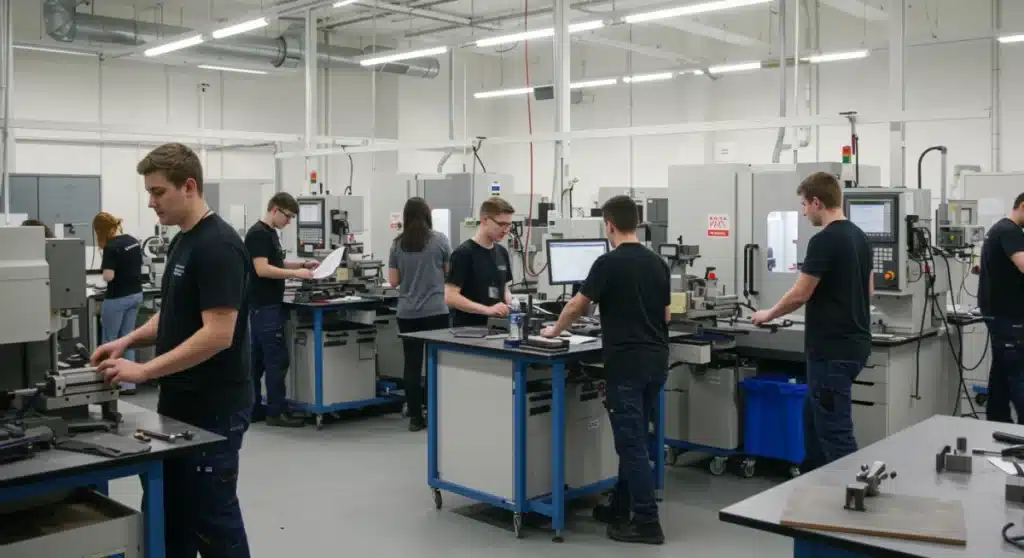
The resurgence of American manufacturing is increasingly driven by automation, robotics, and advanced digital processes. This evolution demands a workforce with a new set of skills, moving beyond traditional assembly line work to include programming, maintenance of robotic systems, and quality control using sophisticated tools. Vocational training is pivotal in bridging this skills gap.
Advanced manufacturing facilities leverage technologies such as additive manufacturing (3D printing), computer-aided design (CAD), and computer-aided manufacturing (CAM). These programs prepare individuals to operate and maintain the complex machinery that defines modern production processes. The focus is on precision, efficiency, and innovation, ensuring that U.S. manufacturing remains globally competitive.
Robotics and Automation Specialists
The integration of robots into manufacturing processes has created a demand for technicians who can program, troubleshoot, and maintain these sophisticated machines. Vocational programs in this area provide comprehensive training in robotics, automation control, and industrial programming. These specialists are essential for optimizing production lines and ensuring operational continuity.
- Robotics technician: Installing, programming, and maintaining industrial robots.
- Automation engineer assistant: Supporting the design and implementation of automated systems.
- Mechatronics specialist: Combining mechanical, electrical, and computer engineering skills.
- CNC machinist: Operating computer numerical control machines for precision manufacturing.
The curriculum often includes modules on sensor technology, programmable logic controllers (PLCs), and human-machine interface (HMI) systems. Practical labs and simulations are integral to these programs, allowing students to gain hands-on experience with the same equipment used in modern factories. This ensures that graduates are well-prepared for the demands of highly automated environments.
Infrastructure and Skilled Trades Revitalization
With significant investments planned for infrastructure upgrades across the U.S., the demand for skilled tradespeople is projected to soar. From modernizing transportation networks to improving public utilities, these projects require a vast workforce with expertise in construction, electrical work, plumbing, and other essential trades. Vocational training programs are critical for supplying this much-needed talent.
The revitalization of infrastructure is not just about building new structures; it also involves maintaining and upgrading existing systems to meet contemporary standards and technological demands. These vocational careers offer excellent earning potential, job security, and the satisfaction of contributing to tangible community development. Many programs also incorporate apprenticeships, providing on-the-job training alongside classroom instruction.
Modernizing Construction and Utilities
The construction and utilities sectors are integrating new technologies and sustainable practices, requiring tradespeople to possess advanced skills. Vocational programs are evolving to include training in smart building technologies, sustainable construction methods, and advanced diagnostic tools. This ensures that the workforce is ready for the challenges of modern infrastructure projects.
- Electrician: Installing and maintaining electrical systems, including smart home technology.
- HVAC technician: Specializing in energy-efficient heating, ventilation, and air conditioning systems.
- Plumber: Working with advanced water conservation systems and smart plumbing.
- Construction manager assistant: Supporting project planning and execution with digital tools.
These programs often emphasize safety protocols, blueprint reading, and the use of specialized equipment. Certifications and licenses are frequently required in these trades, and vocational training programs are designed to help students meet these requirements, preparing them for successful careers in essential industries.
| Key Sector | Description of Opportunities |
|---|---|
| Technology & Digital Trades | Cybersecurity, data analysis, cloud computing, AI support roles. |
| Healthcare Services | Medical assistants, surgical technologists, diagnostic sonographers. |
| Green Energy | Solar panel installers, wind turbine technicians, energy auditors. |
| Advanced Manufacturing | Robotics technicians, automation specialists, CNC machinists. |
Frequently Asked Questions About 2026 Vocational Training
Vocational training in 2026 offers quicker entry into the workforce, lower educational costs compared to traditional degrees, and direct pathways to high-demand careers. Graduates gain practical, job-specific skills highly valued by employers, leading to strong employment prospects and competitive salaries in emerging fields.
The new programs are characterized by their strong alignment with current industry needs, integrating advanced technologies like AI and robotics. They often include stackable credentials, flexible learning options, and enhanced industry partnerships, making them more responsive to the evolving job market than older models.
Key growth industries include technology (cybersecurity, cloud computing), healthcare (allied health services), green energy (solar, wind), and advanced manufacturing (robotics, automation). These sectors are experiencing significant demand for skilled technicians and specialists, offering robust career opportunities.
Yes, numerous financial aid options exist, including federal grants, state-funded scholarships, and institutional aid. Many programs also qualify for federal student loans, and some employers offer tuition reimbursement. It’s advisable to research specific programs and consult financial aid advisors.
Look for programs accredited by recognized agencies, those with strong industry partnerships, and high job placement rates. Research reviews, visit campuses, and speak with current students or alumni. State workforce development agencies can also provide valuable information and recommendations for quality programs.
Conclusion
The emergence of new vocational training programs in the U.S. for 2026 represents a pivotal moment for career development and economic growth. These initiatives are meticulously crafted to meet the demands of an ever-changing job market, offering accessible and efficient pathways to high-demand careers in vital sectors such as technology, healthcare, green energy, and advanced manufacturing. By focusing on practical skills, industry relevance, and direct employment opportunities, vocational education is reaffirming its role as a powerful engine for individual prosperity and national competitiveness. For those seeking meaningful and secure employment, these programs offer a compelling alternative to traditional higher education, providing the tools and knowledge necessary to thrive in the economy of tomorrow.