Navigating 2026 Federal Reserve Interest Rate Hikes: Mortgage Impact Explained

As we look towards 2026, the whispers of potential Federal Reserve interest rate hikes grow louder. For many, especially homeowners and those dreaming of buying a home, these discussions bring a mix of anticipation and apprehension. Understanding the intricate dance between the Federal Reserve, the broader economy, and your personal finances, particularly your mortgage, is paramount. This comprehensive guide will delve into what a potential 0.25% increase in the federal funds rate could mean for your mortgage interest rates and offer actionable strategies to navigate these changes effectively.
The Federal Reserve plays a pivotal role in the economic landscape of the United States. Its decisions on interest rates ripple through every sector, from consumer loans to business investments. When the Fed signals a potential hike, even a seemingly modest 0.25%, it’s not just a number; it’s a catalyst for significant shifts in borrowing costs. For homeowners, this directly translates to changes in adjustable-rate mortgages (ARMs) and influences the rates available for new fixed-rate mortgages. Prospective buyers, on the other hand, face a potentially more expensive entry into the housing market.
Our focus today is on demystifying these complexities, providing clarity on the mechanisms at play, and equipping you with the knowledge to make informed decisions. We’ll explore the historical context of Fed rate hikes, analyze the specific impact of a 0.25% increase on various mortgage types, and discuss proactive measures you can take to protect your financial well-being. By the end of this article, you will have a clear understanding of how to prepare for and potentially thrive amidst changing mortgage interest rates.
Understanding the Federal Reserve and Its Influence on Mortgage Interest Rates
Before we dive into the specifics of 2026, it’s crucial to grasp the Federal Reserve’s role and how its actions directly impact mortgage interest rates. The Federal Reserve, often referred to as ‘the Fed,’ is the central banking system of the United States. Its primary mandates are to maximize employment, stabilize prices, and moderate long-term interest rates. To achieve these goals, the Fed utilizes various monetary policy tools, with the federal funds rate being one of the most powerful.
The Federal Funds Rate Explained
The federal funds rate is the target interest rate set by the Federal Open Market Committee (FOMC) for overnight borrowing between banks. While it’s not the rate consumers pay, it serves as a benchmark for other short-term interest rates. When the Fed raises the federal funds rate, it generally makes it more expensive for banks to borrow money, and these increased costs are then passed on to consumers in the form of higher interest rates on various loans, including credit cards, auto loans, and, indirectly, mortgages.
How the Federal Funds Rate Affects Mortgage Interest Rates
The relationship between the federal funds rate and mortgage interest rates is not always direct or immediate, but it is significant. Mortgage rates, particularly for 30-year fixed-rate mortgages, are more closely tied to the yield on 10-year Treasury bonds. However, expectations of future Fed actions, including potential rate hikes, often influence Treasury yields. If the market anticipates the Fed will continue raising rates, bond yields tend to rise, pushing mortgage interest rates higher.
For adjustable-rate mortgages (ARMs), the connection is more direct. ARMs are typically tied to a specific index, such as the Secured Overnight Financing Rate (SOFR) or the London Interbank Offered Rate (LIBOR, though largely phased out), which are more directly influenced by the federal funds rate. When the Fed raises its benchmark rate, the underlying index for ARMs usually increases, leading to higher monthly payments for borrowers once their initial fixed-rate period ends.
Historical Context of Fed Rate Hikes
Looking back at history provides valuable insights. The Fed often raises interest rates to combat inflation when the economy is growing robustly. Conversely, it lowers rates during economic downturns to stimulate borrowing and spending. The period leading up to 2026 might see the Fed continuing a path of cautious tightening if inflation remains stubbornly high or if economic growth is strong enough to withstand higher borrowing costs. Even small, incremental increases, like 0.25%, can accumulate and have a substantial long-term impact on your financial obligations, especially on significant loans like mortgages. Understanding these historical patterns helps us contextualize potential future actions and prepare for their implications on mortgage interest rates.
The 0.25% Increase: What It Really Means for Your Mortgage
A 0.25% increase in the federal funds rate might sound insignificant, but its ripple effect on your mortgage can be quite substantial, especially over the lifetime of a loan. Let’s break down the impact on different types of mortgages and illustrate with practical examples.
Impact on Adjustable-Rate Mortgages (ARMs)
If you have an adjustable-rate mortgage, a 0.25% federal funds rate hike will likely translate into a similar increase in your mortgage interest rate once the fixed-rate period expires and the loan adjusts. ARMs typically have an initial fixed period (e.g., 3/1, 5/1, 7/1, or 10/1), after which the interest rate adjusts periodically based on a predetermined index plus a margin. If your ARM is due to adjust around 2026 and the Fed has raised rates, your monthly payments will almost certainly go up.
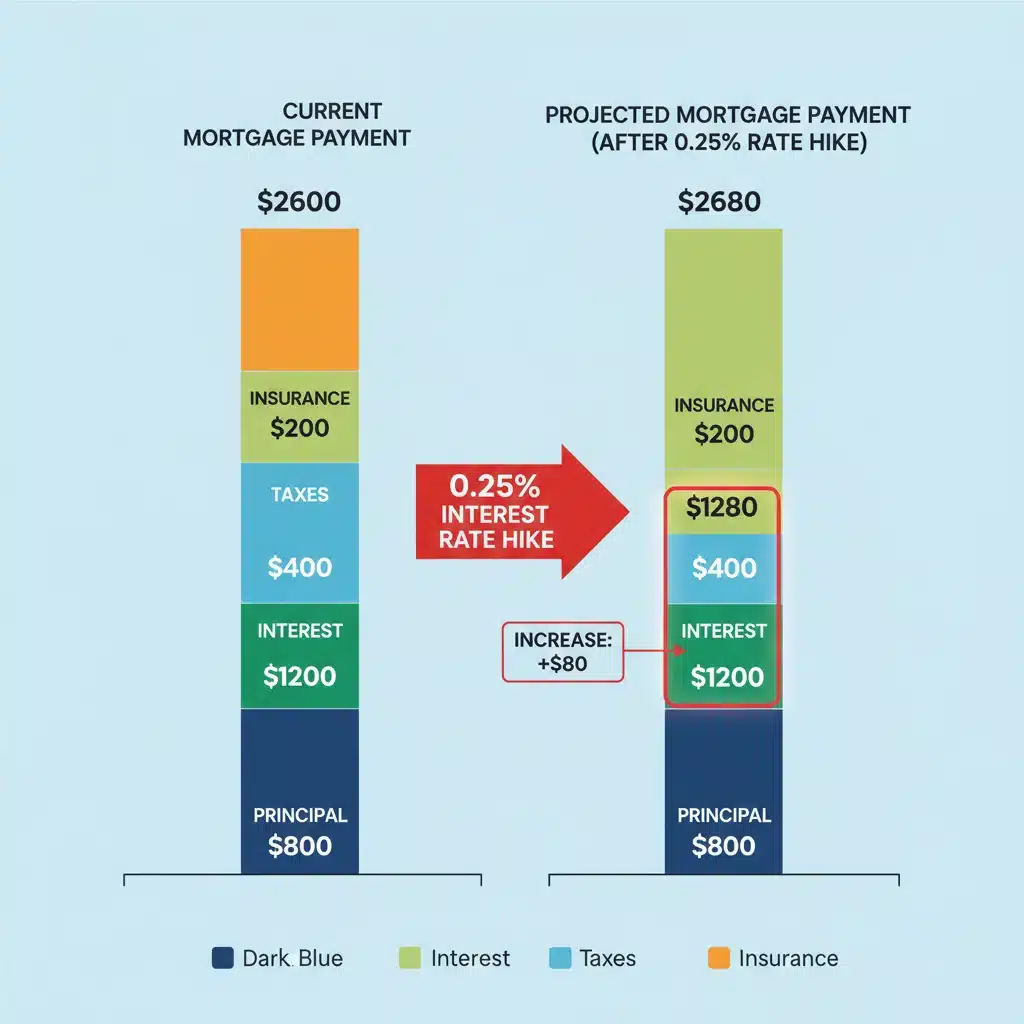
Example: Suppose you have a $300,000 ARM with an initial rate of 4.0% that is about to adjust. If the rate increases by 0.25% to 4.25%, your monthly principal and interest payment could increase by approximately $40-$50. While this might seem small on a monthly basis, over a year, it adds up to an extra $480-$600, and over the remaining life of the loan, it can be thousands of dollars. The cumulative effect of rising mortgage interest rates can significantly alter your household budget.
Impact on Fixed-Rate Mortgages
For those with existing fixed-rate mortgages, a Fed rate hike in 2026 will not directly change your current monthly payments. Your interest rate is locked in for the life of the loan. This is one of the primary advantages of a fixed-rate mortgage: predictability and protection against rising mortgage interest rates.
However, if you are considering refinancing an existing fixed-rate mortgage, a Fed hike will mean higher rates available in the market. This could make refinancing less attractive or even detrimental if your current rate is lower than the new market rates. Similarly, if you are planning to purchase a home with a new fixed-rate mortgage, expect to encounter higher rates than you would have before the hike. This directly impacts affordability and purchasing power.
Example: A new homebuyer looking for a $400,000 30-year fixed-rate mortgage. If the rate goes from 6.0% to 6.25%, their monthly principal and interest payment would increase from approximately $2,398 to $2,463. This is an extra $65 per month, or $780 per year. Over the 30-year term, this seemingly small 0.25% increase translates to an additional $23,400 in interest paid over the life of the loan. This clearly illustrates the long-term financial implications of even a small change in mortgage interest rates.
The Broader Housing Market Implications
Beyond individual mortgages, rising interest rates have broader implications for the housing market. Higher mortgage interest rates generally lead to:
- Reduced Affordability: As borrowing costs increase, fewer potential buyers can afford the same home price, potentially cooling demand.
- Slower Home Price Appreciation: With reduced demand and affordability, the rapid home price growth seen in recent years might slow down or even reverse in some markets.
- Increased Inventory: Some homeowners might choose not to sell if they have a low fixed-rate mortgage, but overall, a cooler market could lead to more homes staying on the market longer.
- Impact on Refinancing: Higher rates make refinancing less appealing for many homeowners, especially those with historically low rates.
For those with existing ARMs, the prospect of rising mortgage interest rates makes understanding your loan terms and exploring options like refinancing to a fixed-rate mortgage even more critical before the rates climb higher. For prospective buyers, it underscores the importance of budgeting carefully and considering how future rate increases might affect your long-term financial plans. The key is to be proactive rather than reactive when it comes to changes in mortgage interest rates.
Strategies for Homeowners with Existing Mortgages
If you’re already a homeowner, the potential for rising mortgage interest rates in 2026 necessitates a review of your current mortgage situation. Proactive planning can help you mitigate risks and potentially save money in the long run.
Review Your Mortgage Type and Terms
The first step is to thoroughly understand your current mortgage. Do you have a fixed-rate or an adjustable-rate mortgage (ARM)?
- Fixed-Rate Mortgage: If you have a fixed-rate mortgage, your principal and interest payments will remain unchanged regardless of Fed rate hikes. You are largely insulated from the direct impact of rising mortgage interest rates on your monthly payment. However, consider if your current rate is significantly higher than what might become available if rates unexpectedly drop in the future (though this is less likely with anticipated hikes).
- Adjustable-Rate Mortgage (ARM): If you have an ARM, pay close attention to your adjustment period. When is your next rate adjustment scheduled? What index is your ARM tied to, and what is your margin? Understanding these details is crucial for forecasting potential payment increases.
Consider Refinancing to a Fixed-Rate Mortgage
For ARM holders, or those with fixed-rate mortgages at a relatively high rate, refinancing to a new fixed-rate mortgage could be a wise move, especially if you anticipate rising mortgage interest rates. By locking in a fixed rate now, you can protect yourself from future payment increases. This decision should be based on several factors:
- Current Market Rates: Compare your existing ARM rate (or your current fixed rate) with prevailing fixed rates. If current fixed rates are still favorable, it might be an opportune time to refinance.
- Time Until Adjustment: If your ARM is due to adjust soon, the urgency to refinance is greater.
- Closing Costs: Remember that refinancing involves closing costs. Calculate whether the savings from a lower fixed rate (or avoiding a higher ARM rate) outweigh these upfront costs.
- Future Plans: How long do you plan to stay in your home? If it’s for the long term, the stability of a fixed rate is often more appealing.
Make Extra Principal Payments
Regardless of your mortgage type, making extra principal payments can be a highly effective strategy. By reducing your loan’s principal balance, you achieve several benefits:
- Reduce Total Interest Paid: A smaller principal means less interest accrues over the life of the loan.
- Build Equity Faster: Accelerate your equity growth, providing a stronger financial position.
- Lower Future Payments (for ARMs): If you have an ARM and you reduce your principal before an adjustment, the new, higher interest rate will be applied to a smaller loan amount, mitigating the payment increase.
Even small, consistent extra payments can make a significant difference. Consider round-up apps, bi-weekly payments, or dedicating tax refunds or bonuses to your principal.
Build an Emergency Fund
A robust emergency fund is always a cornerstone of sound financial planning, but it becomes even more critical when facing potential increases in mortgage interest rates. Aim for at least 3-6 months’ worth of essential living expenses, including your new, potentially higher, mortgage payment. This fund acts as a buffer, providing financial security in case of unexpected expenses or income disruptions, preventing you from defaulting on your mortgage.
Consult with a Financial Advisor or Mortgage Professional
Navigating the complexities of mortgage interest rates and economic forecasts can be challenging. A qualified financial advisor or mortgage professional can offer personalized advice based on your specific financial situation and risk tolerance. They can help you analyze your options, calculate potential savings or costs, and guide you through the refinancing process if that’s the best course of action. Their expertise can be invaluable in making informed decisions about your mortgage interest rates.
Advice for Prospective Homebuyers in a Rising Rate Environment
For those looking to purchase a home in 2026, the prospect of rising mortgage interest rates adds another layer of consideration to an already significant financial decision. Here’s how to approach homebuying strategically in this environment.
Get Pre-Approved Early
One of the most important steps for prospective buyers is to get pre-approved for a mortgage as early as possible. A pre-approval not only gives you a clear understanding of how much you can afford but also often allows you to lock in an interest rate for a certain period (e.g., 30, 60, or 90 days). This can protect you from any immediate increases in mortgage interest rates while you search for a home. However, be aware of the lock-in period and its expiration.
Budget for Higher Monthly Payments
When calculating your affordability, don’t just look at today’s rates. Factor in potential future increases in mortgage interest rates. Use online mortgage calculators to estimate how a 0.25% or even 0.50% higher rate would affect your monthly payment. This realistic budgeting ensures you won’t be stretched too thin if rates continue to climb after your purchase. Remember to also account for property taxes, homeowner’s insurance, and potential homeowner’s association (HOA) fees.
Prioritize Down Payment Savings
A larger down payment offers several advantages in a rising rate environment:
- Lower Loan Amount: A larger down payment means you borrow less, which mitigates the impact of higher mortgage interest rates on your monthly payment and total interest paid.
- Better Loan Terms: Lenders often offer more favorable interest rates to borrowers with substantial down payments, as it indicates lower risk.
- Avoid PMI: A down payment of 20% or more typically allows you to avoid Private Mortgage Insurance (PMI), saving you an additional monthly cost.
Consider a Shorter Loan Term
While 30-year fixed-rate mortgages are common, a 15-year fixed-rate mortgage often comes with a lower interest rate. Although the monthly payments will be higher, you’ll pay significantly less interest over the life of the loan and build equity much faster. This can be a smart move if your budget allows for the higher monthly payment, effectively reducing your exposure to long-term interest rate fluctuations.
Explore Different Mortgage Products
While fixed-rate mortgages are generally recommended for stability in a rising rate environment, it’s still worthwhile to understand all available mortgage products. Some lenders might offer specific programs or temporary buy-downs that could be beneficial. However, always approach ARMs with caution if the expectation is for sustained increases in mortgage interest rates, unless you have a clear plan to refinance or sell before the adjustment period.

Don’t Overextend Your Budget
Perhaps the most critical advice: do not overextend yourself financially. In a competitive housing market, it’s easy to get caught up in bidding wars and push your budget beyond comfortable limits. However, with the possibility of higher mortgage interest rates, an already tight budget can quickly become unsustainable. Stick to what you can truly afford, ensuring you have enough room in your budget for unexpected expenses and potential future rate adjustments, especially if you opt for an ARM. Prioritize long-term financial health over short-term desires.
The Broader Economic Landscape and Future Outlook
Understanding the context behind the Federal Reserve’s decisions is crucial for anticipating future movements in mortgage interest rates. The Fed doesn’t raise or lower rates in a vacuum; its actions are a response to the prevailing economic conditions and its outlook for the future.
Inflation as a Key Driver
One of the primary drivers of Fed policy is inflation. When inflation is high and persistent, the Fed typically raises interest rates to cool down the economy, reduce demand, and bring prices back under control. If inflation remains elevated leading up to 2026, further rate hikes, including that 0.25%, become more probable. Conversely, if inflation moderates or falls back to the Fed’s target of around 2%, the pressure for aggressive rate hikes diminishes, potentially stabilizing mortgage interest rates.
Employment and Economic Growth
The state of the labor market and overall economic growth also heavily influence the Fed’s decisions. A strong job market with low unemployment often gives the Fed more leeway to raise rates without fear of triggering a recession. If the economy is growing robustly, it can absorb higher borrowing costs. However, if there are signs of economic slowdown or recession, the Fed might pause or even reverse its rate-hiking policy to stimulate growth, which could lead to lower mortgage interest rates.
Global Economic Factors
The U.S. economy does not operate in isolation. Global economic conditions, geopolitical events, and international trade dynamics can all impact the Federal Reserve’s policy decisions and, consequently, mortgage interest rates. For instance, global supply chain disruptions or major international conflicts can contribute to inflationary pressures or create economic uncertainty, influencing the Fed’s stance.
Forward Guidance and Market Expectations
The Federal Reserve also uses ‘forward guidance’ – communicating its intentions about future monetary policy – to manage market expectations. Statements from FOMC members, minutes from meetings, and economic projections all provide clues about the likely path of interest rates. Financial markets, including the bond market (which influences mortgage interest rates), react swiftly to these signals. Therefore, staying informed about the Fed’s communications is key to understanding potential shifts in mortgage interest rates.
What to Expect in 2026
While no one can predict the future with certainty, the general consensus for 2026 often involves a continued focus on bringing inflation under control while maintaining economic stability. This could mean a period of higher-for-longer interest rates compared to the ultra-low rates of the past decade. The 0.25% increase we’ve discussed is a plausible scenario if the Fed continues its measured approach to monetary policy. However, unforeseen economic shocks or significant changes in inflation or employment data could alter this trajectory. Homeowners and prospective buyers should remain agile and prepared for various scenarios concerning mortgage interest rates.
Conclusion: Proactive Planning is Your Best Defense Against Rising Mortgage Interest Rates
The prospect of the Federal Reserve raising interest rates by 0.25% in 2026 is a significant consideration for anyone with a mortgage or plans to buy a home. While the exact timing and magnitude of future rate hikes remain subject to economic conditions, being prepared is your most powerful tool. Understanding how these changes impact your mortgage interest rates, whether you have an ARM or are considering a new loan, is the first step towards financial resilience.
For current homeowners, reviewing your mortgage terms, exploring refinancing options, and making extra principal payments are all excellent strategies to mitigate the impact of rising mortgage interest rates. Building a robust emergency fund provides a crucial safety net against unforeseen financial challenges. For prospective homebuyers, early pre-approval, diligent budgeting that accounts for higher rates, prioritizing a larger down payment, and considering shorter loan terms can help you navigate the market effectively and secure a more favorable financial position.
The broader economic landscape, driven by inflation, employment, and global factors, will continue to shape the Federal Reserve’s decisions. By staying informed and consulting with financial professionals, you can make strategic choices that protect your financial well-being. Don’t let uncertainty about mortgage interest rates lead to inaction. Take control of your financial future today, ensuring that you are well-positioned to adapt to whatever economic shifts 2026 may bring. Your proactive planning today will translate into peace of mind tomorrow, safeguarding your investment in your home against the fluctuations of mortgage interest rates.