Unemployment Benefits 2025: State Programs Compared for Best Support
Understanding the nuances of state unemployment benefit programs in 2025 is crucial for individuals facing job loss, as eligibility, weekly amounts, and duration vary significantly across the United States.
Navigating the landscape of unemployment benefits can be a complex endeavor, especially when facing the uncertainty of job loss. In 2025, understanding the intricacies of state-specific programs is more critical than ever. This comprehensive analysis focuses on unemployment benefits comparison, delving into which state programs offer the most robust support systems for their residents. From eligibility requirements to weekly benefit amounts and duration, we will explore the key factors that differentiate these vital safety nets.
Understanding the basics of unemployment insurance
Unemployment insurance (UI) is a joint state-federal program designed to provide temporary income support to eligible workers who lose their jobs through no fault of their own. While the federal government establishes broad guidelines, each state administers its own UI program, leading to significant variations in benefits and rules. These differences are not merely bureaucratic; they directly impact the financial stability of individuals and families during periods of economic hardship.
At its core, the UI system aims to stabilize local economies by maintaining purchasing power and providing a cushion for workers to search for new employment without immediate financial destitution. However, the effectiveness of this safety net largely depends on the specific design and funding of each state’s program. Understanding these foundational aspects is the first step in appreciating the complexities of a nationwide comparison.
Eligibility criteria across states
- Work history requirements: Most states require claimants to have earned a certain amount of wages during a “base period” (typically the first four of the last five completed calendar quarters before filing a claim) or worked a minimum number of hours.
- Reason for separation: To be eligible, an individual must generally be unemployed through no fault of their own. This usually excludes those who quit their job voluntarily without good cause or were fired for misconduct.
- Availability and search for work: Claimants must be able and available to work and actively seeking new employment. States often have specific requirements for documenting job search efforts.
The variations in these criteria can be substantial. For example, some states might have more lenient wage requirements, making it easier for part-time or low-wage workers to qualify. Conversely, other states may impose stricter job search mandates, requiring a higher number of documented contacts with potential employers each week. These subtle differences can significantly impact who qualifies for benefits and how long they can receive them.
The basic framework of unemployment insurance is uniform in its intent but diverse in its application. This state-by-state autonomy means that a worker moving from one state to another might find their UI experience vastly different, even if their work history and reason for unemployment are similar. This underscores the importance of a detailed unemployment benefits comparison to truly understand the support available.
Weekly benefit amounts: a state-by-state breakdown
One of the most critical aspects of any unemployment program is the weekly benefit amount (WBA) an individual receives. This figure directly impacts a claimant’s ability to cover essential living expenses. In 2025, WBAs continue to show a wide disparity across U.S. states, reflecting different economic conditions, cost-of-living standards, and legislative priorities.
WBAs are typically calculated based on a claimant’s past earnings during their base period, up to a certain maximum. However, the formulas and maximums vary considerably. States with higher costs of living do not always correlate with higher maximum benefits, creating potential financial strain for unemployed workers in those areas.
Top-tier states for maximum benefits
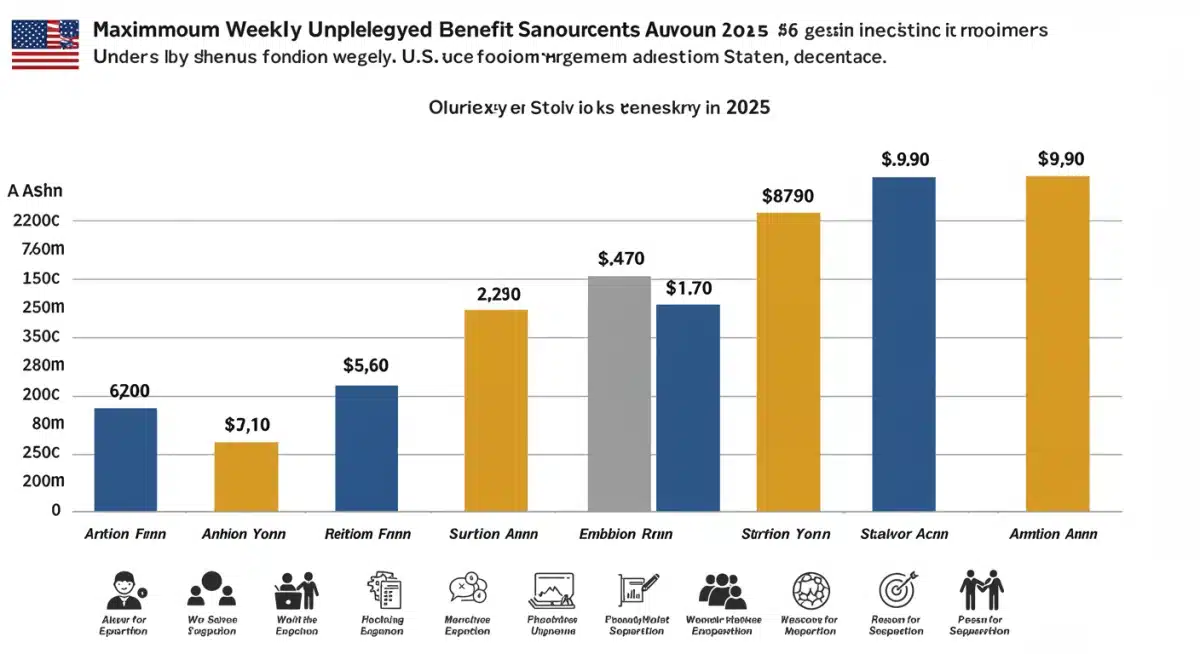
Certain states consistently offer some of the highest maximum weekly benefits. These often include states like Massachusetts, New Jersey, and Washington, where the maximums can exceed $800 or even $900 per week. Such generous provisions provide a more substantial safety net, allowing individuals to maintain a closer approximation of their previous income while seeking new employment.
- Massachusetts: Known for its robust benefits, often including dependents’ allowances.
- New Jersey: Consistently ranks among the highest for maximum weekly payouts.
- Washington: Offers competitive benefits, reflecting the state’s higher cost of living.
These states often have higher average wages, and their UI systems are structured to replace a larger percentage of those wages, up to the maximum. This approach aims to reduce the economic shock of unemployment and support local economies more effectively.
States with lower maximum benefits
Conversely, many states offer significantly lower maximum weekly benefits. States such as Mississippi, Alabama, and Arizona often have maximums below $300 per week. While the cost of living in these states might be lower, these benefit amounts can still present a considerable challenge for claimants trying to cover basic necessities like housing, food, and utilities.
The disparity in WBAs highlights a fundamental challenge in the U.S. unemployment system: a patchwork of state-level programs rather than a unified national standard. This makes a detailed unemployment benefits comparison essential for anyone trying to understand their potential support.
The weekly benefit amount is often the first thing people consider when evaluating unemployment programs. While the maximums provide a benchmark, it is also important to remember that most claimants will receive a percentage of their prior wages, which may be below the state maximum. The actual amount received depends on individual earnings history and state-specific calculation formulas, making personalized assessment crucial.
Duration of benefits: how long can you receive aid?
Beyond the weekly amount, the duration for which unemployment benefits can be received is another critical factor determining the overall support offered by a state program. Most states provide up to 26 weeks of regular unemployment benefits, but this is not a universal standard. Some states have opted for shorter durations, while others have mechanisms for extending benefits during periods of high unemployment.
The standard 26-week period is a long-standing federal guideline, but states have the flexibility to adjust this. For an individual searching for a new job, having more weeks of support can make a significant difference in their financial stability and ability to conduct a thorough job search without undue pressure.
States with extended durations or flexible policies
A few states offer more generous durations or have policies that can extend benefits beyond the typical 26 weeks, especially during economic downturns. These states often have triggers in place that automatically extend benefits when unemployment rates reach certain thresholds. For example, some states might offer an additional 13 weeks of state-funded extended benefits when their insured unemployment rate is particularly high.
- California: While typically 26 weeks, California has historically been proactive in implementing extended benefits during recessions.
- New York: Also adheres to the 26-week standard but has mechanisms for additional support.
- States with high unemployment triggers: Some states have statutory provisions for extending benefits when their unemployment rate rises significantly, providing crucial additional weeks of aid.
These extended benefit programs are often co-funded by federal and state governments and are vital during economic crises. They serve as a crucial lifeline, preventing long-term unemployment from spiraling into deeper financial distress for many families. Understanding these potential extensions is an important part of any comprehensive unemployment benefits comparison.
States with shorter benefit durations
On the other end of the spectrum, some states have reduced the maximum number of weeks for which claimants can receive benefits. States like Florida and North Carolina, for instance, have enacted legislation that shortens the duration of benefits, sometimes to as few as 12-14 weeks, depending on the state’s unemployment rate. This policy decision can significantly impact unemployed workers, forcing them to find new employment more quickly or face a longer period without income.
The rationale behind shorter durations often includes arguments about incentivizing quicker reemployment and managing state UI trust fund solvency. However, critics argue that such policies can leave vulnerable populations without adequate support, especially in a challenging job market. The duration of benefits is a stark indicator of a state’s commitment to supporting its unemployed workforce.
Impact of state economy and legislative changes
The structure and generosity of state unemployment benefit programs are not static; they are heavily influenced by a state’s economic health and legislative priorities. A strong economy with low unemployment might lead to less pressure on UI trust funds, potentially allowing for more generous benefits or stable durations. Conversely, economic downturns can strain these funds, sometimes prompting states to reduce benefits or tighten eligibility to maintain solvency.
Legislative changes are also a constant factor. State legislatures regularly review and amend UI laws, often in response to economic conditions, political ideologies, or lessons learned from previous recessions. These changes can be significant, altering benefit amounts, eligibility rules, and benefit duration periods.
Economic factors influencing UI programs
- Unemployment rate: Higher unemployment rates put more strain on UI trust funds, potentially leading to calls for reform.
- State budget health: A state’s overall financial health can dictate how much it can contribute to or support its UI program.
- Industry composition: States with volatile industries might experience more frequent and severe unemployment spikes, impacting their UI system stability.
For example, states with diversified economies might have more stable UI trust funds compared to those heavily reliant on a single industry prone to boom-and-bust cycles. These underlying economic realities play a crucial role in shaping the long-term sustainability and generosity of unemployment benefits. Therefore, a meaningful unemployment benefits comparison must consider these broader economic contexts.
Recent legislative trends
In recent years, several states have moved to reform their UI systems. Some have aimed to modernize their systems, improve claims processing, and enhance fraud detection. Others have focused on adjusting benefit levels or duration, often in response to the massive payouts during the COVID-19 pandemic and the subsequent need to rebuild UI trust fund balances.
These legislative trends can create a dynamic environment where the “best” state for unemployment benefits can change over time. Staying informed about proposed and enacted legislation is crucial for both policymakers and individuals who may need to rely on these benefits in the future. The political climate and fiscal philosophies of a state’s leadership often dictate the direction of these reforms, leading to a continuous evolution of UI programs.
Application process and support services
Beyond the financial aspects, the ease of applying for unemployment benefits and the availability of support services are critical components of a state’s overall program quality. A high weekly benefit amount means little if the application process is overly burdensome, confusing, or inaccessible. In 2025, states are increasingly focusing on modernizing their UI systems to improve user experience and streamline claims processing.
The application process typically involves submitting a claim online, by phone, or in person, providing detailed information about work history, reason for separation, and personal identification. After filing, claimants usually need to certify their eligibility weekly or bi-weekly, confirming they are still unemployed, able to work, and actively seeking employment.
Streamlined vs. complex application systems
- User-friendly online portals: States like Oregon and Colorado have invested in intuitive online platforms that simplify the application and weekly certification process.
- Personalized assistance: Some states offer more robust call centers and in-person support to help claimants navigate the system, which is especially beneficial for those less familiar with online processes.
- Documentation requirements: The complexity of required documentation can vary, with some states demanding more extensive proof of job search efforts or prior earnings.
States that have invested in modern IT infrastructure and human resources for their UI departments tend to offer a smoother experience. This not only reduces stress for claimants but also allows for faster processing of claims, ensuring that individuals receive their benefits in a timely manner. Delays in receiving benefits can exacerbate financial hardship, regardless of the ultimate benefit amount.
Additional support services
Many state UI agencies also offer a range of support services designed to help claimants return to work. These can include job search assistance, resume writing workshops, interview coaching, and access to job boards. Some states even provide training programs or reemployment services for those looking to transition into new careers.
The availability and quality of these supplementary services can significantly enhance the value of a state’s unemployment program. For instance, a state that proactively connects claimants with employment resources might be considered more supportive, even if its weekly benefit amount isn’t the absolute highest. This holistic view is essential for a complete unemployment benefits comparison.
Comparing state programs: what makes a program “best”?
Determining which state program offers the “best” support in 2025 is not a one-size-fits-all answer. It depends heavily on an individual’s specific circumstances, including their prior earnings, family situation, and the duration of their unemployment. However, a comprehensive assessment involves looking at several key indicators that collectively paint a picture of a program’s generosity and effectiveness.
A “best” program typically combines a high weekly benefit amount with a reasonable duration, straightforward eligibility criteria, and an efficient, user-friendly application process. States that also offer robust reemployment services and support for dependents further enhance their appeal.
Key indicators for evaluation
- Maximum weekly benefit amount: A higher maximum provides a better income replacement rate for many.
- Benefit duration: Longer durations offer more stability during extended job searches.
- Eligibility simplicity: Clear and accessible requirements reduce barriers to accessing aid.
- Application efficiency: A streamlined process ensures timely receipt of benefits.
- Reemployment services: Support for finding new work is invaluable.
- Dependent allowances: Some states offer additional funds for claimants with dependents, significantly increasing overall support.
When conducting an unemployment benefits comparison, it’s crucial to consider how these factors interact. A state might have a high maximum benefit but a very short duration, or vice versa. The ideal program strikes a balance, providing adequate financial relief while also facilitating a return to employment.
Regional considerations and cost of living
It is also important to contextualize benefit amounts with the local cost of living. A $500 weekly benefit in a state with a low cost of living might provide more purchasing power than a $700 benefit in a state with an extremely high cost of living. Therefore, individuals should research not just the raw numbers but also their real-world value in their specific location.
Furthermore, states with strong economies and lower unemployment rates might inherently offer a better overall environment for job seekers, even if their UI benefits are not the highest. The combination of a safety net and a favorable job market often represents the most supportive scenario for individuals facing unemployment.
Future outlook and potential reforms in 2025
The landscape of unemployment benefits is continually evolving, and 2025 is likely to bring further discussions and potential reforms. The lessons learned from recent economic challenges, particularly the unprecedented expansion of UI during the COVID-19 pandemic, continue to shape policy debates at both federal and state levels. These discussions often revolve around balancing claimant support with the solvency of state UI trust funds and encouraging reemployment.
One area of ongoing focus is the modernization of state UI IT systems. Many states operate on outdated technology, which was exposed during the surge in claims. Investments in modern infrastructure can lead to more efficient processing, reduce fraud, and improve the overall experience for claimants.
Federal involvement and potential new standards
- Calls for federal minimum standards: There are recurring discussions about establishing federal minimum standards for weekly benefit amounts and duration to reduce state-to-state disparities.
- Automatic stabilizers: Proposals for federal programs that automatically trigger extended benefits during recessions, independent of state actions.
- UI trust fund solvency: Federal incentives or mandates to ensure states maintain healthy UI trust fund balances to prevent insolvency during economic downturns.
Any significant federal intervention would fundamentally alter the current state-centric system, potentially leading to a more uniform and robust national safety net. However, such changes often face political hurdles due to differing state priorities and fiscal philosophies. A more standardized approach could simplify the unemployment benefits comparison, making it easier for individuals to understand their entitlements regardless of where they reside.
State-level innovations and challenges
At the state level, innovations may continue in areas such as proactive outreach to eligible workers, enhanced reemployment services, and exploring alternative benefit structures. However, states will also grapple with challenges like adapting to the changing nature of work (e.g., gig economy workers) and ensuring their UI systems are resilient enough to handle future economic shocks.
The future of unemployment benefits in 2025 will likely be a blend of technological advancements, legislative adjustments, and ongoing efforts to find the right balance between supporting unemployed workers and maintaining fiscal responsibility. Staying informed about these developments will be crucial for anyone interested in the evolving landscape of worker support programs.
| Key Aspect | Brief Description |
|---|---|
| Eligibility Criteria | Requirements for work history, reason for job loss, and active job search vary significantly by state. |
| Weekly Benefit Amount | Calculated based on past earnings, with maximums ranging from under $300 to over $900 across states. |
| Benefit Duration | Most states offer up to 26 weeks, but some provide shorter periods (12-14 weeks) or extended benefits during recessions. |
| Application & Support | Efficiency of online portals and availability of reemployment services vary, impacting overall claimant experience. |
Frequently asked questions about unemployment benefits in 2025
Generally, you must have lost your job through no fault of your own, have earned a certain amount of wages during a base period, and be able, available, and actively seeking work. Specific requirements, including wage thresholds and job search efforts, vary significantly by state.
States like Massachusetts, New Jersey, and Washington often rank among those with the highest maximum weekly benefit amounts. These states frequently offer over $800 or $900 per week, reflecting higher average wages and cost of living in those regions.
The standard duration for regular unemployment benefits in most states is up to 26 weeks. However, some states have shorter durations, sometimes as low as 12-14 weeks, while others may offer extensions during periods of high unemployment.
Yes, unemployment benefits are generally considered taxable income by the federal government and most state governments. You will receive a Form 1099-G from your state unemployment agency, reporting the total amount of benefits paid to you during the year.
If state benefits are insufficient, consider exploring local charities, food banks, rental assistance programs, and other social services. Additionally, some states offer reemployment services, job training, and career counseling to help you find new work faster.
Conclusion
The landscape of unemployment benefits in the United States for 2025 remains a complex tapestry of state-specific programs, each with its unique strengths and limitations. While some states stand out for their generous weekly benefit amounts and robust support services, others present more restrictive eligibility and shorter durations. For individuals facing job loss, a thorough unemployment benefits comparison is not merely an academic exercise; it is a vital step in understanding the financial safety net available to them. As economies evolve and legislative priorities shift, staying informed about these critical programs will continue to be essential for ensuring financial stability during periods of unemployment. The ultimate goal remains to provide adequate, timely support that allows individuals to bridge the gap between jobs and contribute once again to the workforce.