Navigating 2026 Capital Gains Tax Thresholds: Investor’s Guide
In the dynamic world of investments, staying ahead of tax policy changes is not just advisable; it’s essential for optimizing your financial outcomes. As we approach 2026, a new set of capital gains tax thresholds is on the horizon, promising to reshape how investors approach their portfolios and year-end planning. Understanding these changes, particularly the new 2026 Capital Gains thresholds, is paramount for both seasoned investors and those just starting their wealth-building journey.
Capital gains tax is levied on the profit you make from selling an asset that has increased in value. This can include stocks, bonds, real estate, and even certain collectibles. The tax rate you pay depends on several factors: your income level, your filing status, and, crucially, how long you held the asset. This distinction between short-term and long-term capital gains is a cornerstone of tax planning, and the 2026 adjustments will further emphasize its importance.
The upcoming changes to the 2026 Capital Gains tax thresholds are not merely technical adjustments; they represent a significant shift that could directly impact your investment returns and overall financial strategy. Ignoring these changes could lead to unexpected tax liabilities, while proactively understanding and adapting to them can unlock substantial tax savings and enhance your investment performance. This comprehensive guide aims to demystify the new 2026 Capital Gains tax landscape, providing you with the knowledge and strategies needed to navigate it successfully.
Understanding the Basics of Capital Gains Tax
Before diving into the specifics of the 2026 Capital Gains thresholds, it’s beneficial to revisit the fundamental principles of capital gains tax. This foundational knowledge will help you better appreciate the nuances of the upcoming changes and how they might apply to your unique financial situation.
Short-Term vs. Long-Term Capital Gains
The duration for which you hold an asset before selling it is the primary determinant of whether your gain is considered short-term or long-term. This distinction is critical because it directly impacts the tax rate applied to your profits.
- Short-Term Capital Gains: These are profits from assets held for one year or less. Short-term capital gains are taxed at your ordinary income tax rate. This means they are added to your other taxable income (like salary) and subjected to the same progressive tax brackets.
- Long-Term Capital Gains: These are profits from assets held for more than one year. Long-term capital gains generally benefit from preferential tax rates, which are typically lower than ordinary income tax rates. This favorable treatment is designed to encourage long-term investment.
The 2026 Capital Gains thresholds will primarily affect these long-term rates and the income brackets to which they apply. Understanding this distinction is the first step in effective tax planning for your investments.
How Capital Gains Tax is Calculated
Calculating capital gains tax involves a few straightforward steps:
- Determine Your Cost Basis: This is generally the original purchase price of the asset, plus any commissions or fees paid, and any improvements made (especially relevant for real estate).
- Calculate Your Net Sales Price: This is the sale price minus any selling expenses.
- Find Your Capital Gain (or Loss): Subtract your cost basis from your net sales price. If the result is positive, you have a capital gain. If it’s negative, you have a capital loss.
- Apply the Correct Tax Rate: Based on whether the gain is short-term or long-term, and your overall taxable income, the appropriate tax rate is applied.
For example, if you bought 100 shares of XYZ stock for $50 per share (cost basis of $5,000) and sold them a year and a half later for $75 per share (net sales price of $7,500), your long-term capital gain would be $2,500. This gain would then be subject to the long-term capital gains tax rate applicable to your income bracket in 2026.
The New 2026 Capital Gains Tax Thresholds: What’s Changing?
The specifics of the 2026 Capital Gains tax thresholds are critical for every investor. While exact figures are subject to legislative adjustments and inflation, the general direction and structure are becoming clearer. These changes are often driven by economic conditions, fiscal policy objectives, and the need to adjust for inflation over time.
Expected Adjustments to Tax Brackets
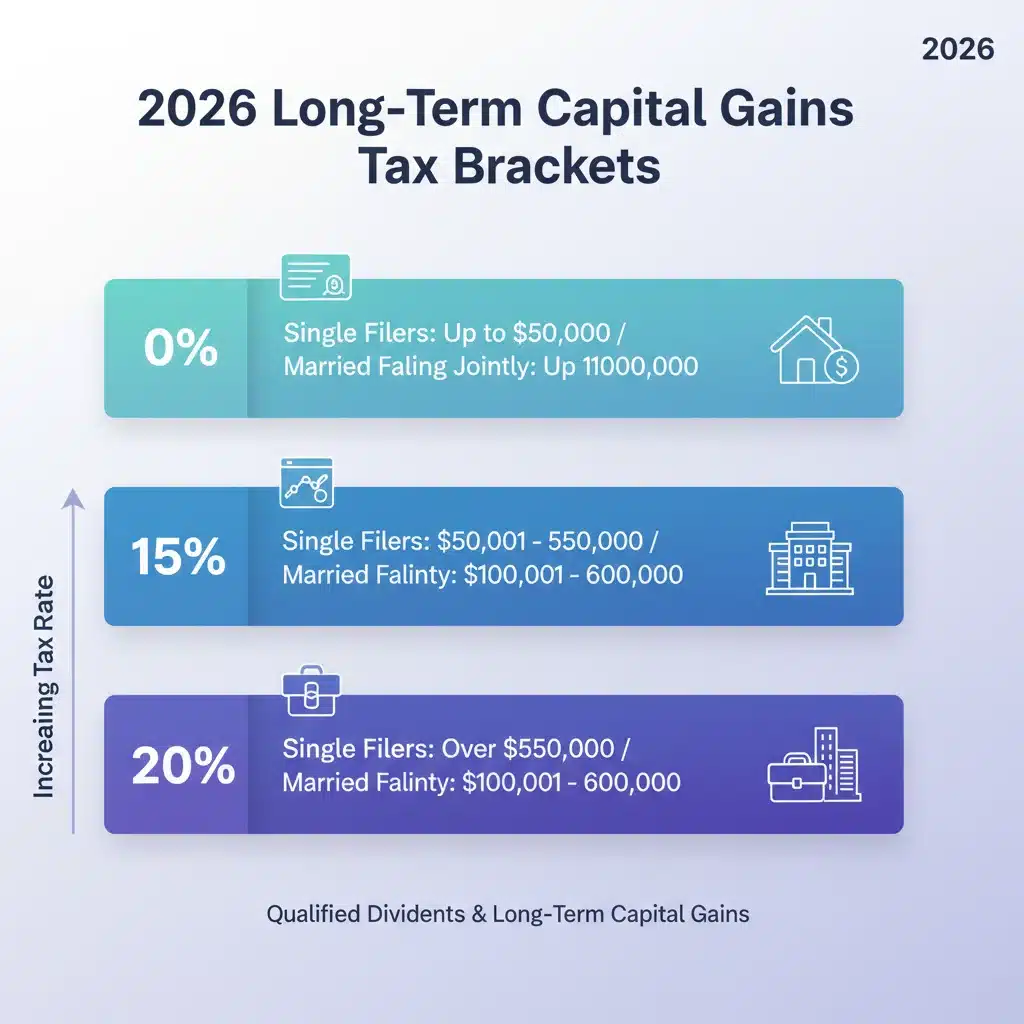
The most significant impact of the 2026 Capital Gains changes will likely be seen in the income thresholds that define the various long-term capital gains tax rates. Currently, there are three primary long-term capital gains tax rates: 0%, 15%, and 20%. These rates apply based on your taxable income, not just your capital gains.
- 0% Rate: This rate typically applies to individuals and married couples filing jointly whose taxable income falls below a certain threshold. For 2026, these thresholds are expected to be adjusted upwards, meaning more individuals might qualify for the 0% rate, or existing beneficiaries could have a larger portion of their income fall into this bracket.
- 15% Rate: This is the most common long-term capital gains rate, applying to a broad range of middle to upper-middle-income earners. The income bands for this rate will also be recalibrated, potentially shifting where many investors fall within the tax structure.
- 20% Rate: This highest long-term capital gains rate is reserved for high-income earners. The new 2026 Capital Gains thresholds will define the exact income level at which this rate kicks in, which could be a significant consideration for affluent investors.
It’s crucial to remember that these thresholds are for taxable income, which includes your ordinary income (wages, interest, etc.) plus your net capital gains. Therefore, even if your capital gains are modest, your overall income could push you into a higher capital gains tax bracket.
Impact on Net Investment Income Tax (NIIT)
For high-income earners, the Net Investment Income Tax (NIIT) remains a significant consideration. This 3.8% tax applies to the lesser of your net investment income (which includes capital gains) or the amount by which your modified adjusted gross income exceeds certain thresholds ($200,000 for single filers, $250,000 for married filing jointly in previous years, subject to inflation adjustments). The 2026 Capital Gains changes, while directly altering capital gains rates, can indirectly affect your NIIT liability by changing your overall modified adjusted gross income.
State-Level Capital Gains Taxes
It’s also vital to remember that federal 2026 Capital Gains thresholds are only part of the picture. Many states impose their own capital gains taxes, often at rates that mirror their ordinary income tax rates. These state-level taxes can significantly impact your net returns, and their thresholds and rates may or may not align with federal changes. Investors should always consider both federal and state tax implications when planning their investment strategies.
Strategic Year-End Planning for the 2026 Capital Gains Thresholds
With the new 2026 Capital Gains thresholds on the horizon, proactive year-end tax planning becomes more critical than ever. Strategic moves made before the end of the tax year can significantly reduce your tax burden and improve your overall investment performance. Here are some key strategies to consider:
1. Tax-Loss Harvesting
Tax-loss harvesting is a time-honored strategy that involves selling investments at a loss to offset capital gains and, potentially, a limited amount of ordinary income. This strategy is particularly powerful when anticipating changes in capital gains tax rates or when you have realized significant gains throughout the year.
- Offsetting Gains: Capital losses can first be used to offset any capital gains you have realized.
- Offsetting Ordinary Income: If your capital losses exceed your capital gains, you can use up to $3,000 of the remaining loss to offset ordinary income each year. Any unused losses can be carried forward indefinitely to future tax years.
As you plan for the 2026 Capital Gains environment, reviewing your portfolio for underperforming assets that can be sold at a loss can be a highly effective way to manage your tax liability. Ensure you adhere to the wash-sale rule, which prevents you from buying a substantially identical security within 30 days before or after selling it at a loss.
2. Gifting Appreciated Assets
Gifting appreciated assets to family members or charities can be a powerful tax-saving strategy, especially in light of the 2026 Capital Gains thresholds. If you gift appreciated assets to a charity, you generally don’t pay capital gains tax on the appreciation, and you may be able to claim an itemized deduction for the fair market value of the gift.
Gifting appreciated assets to individuals can also be beneficial, particularly if the recipient is in a lower tax bracket. The recipient takes on your cost basis, but when they sell the asset, their capital gains tax will be calculated at their potentially lower rate. This strategy requires careful planning regarding gift tax exclusions and the recipient’s tax situation.
3. Utilizing Tax-Advantaged Accounts
Tax-advantaged accounts like 401(k)s, IRAs (Traditional and Roth), and Health Savings Accounts (HSAs) offer significant tax benefits that can help mitigate the impact of 2026 Capital Gains taxes. Contributions to Traditional IRAs and 401(k)s are often tax-deductible, reducing your current taxable income. Investments within these accounts grow tax-deferred, meaning you don’t pay capital gains tax until withdrawal (in retirement).
Roth IRAs, while not offering an upfront tax deduction, allow for tax-free withdrawals in retirement, including all capital gains, provided certain conditions are met. HSAs offer a triple tax advantage: tax-deductible contributions, tax-free growth, and tax-free withdrawals for qualified medical expenses. Maximizing contributions to these accounts should be a cornerstone of your year-end planning.
4. Timing of Sales and Purchases
The timing of when you sell assets can have a profound impact on your capital gains tax liability, especially with new 2026 Capital Gains thresholds. If you anticipate being in a lower tax bracket in a future year (e.g., due to retirement or a career change), deferring the sale of highly appreciated assets until that time could result in significant tax savings. Conversely, if you expect to be in a higher tax bracket in the future, realizing gains in the current year might be more advantageous.
This strategy requires careful forecasting of your income and tax situation, and it’s always wise to consult with a financial advisor to model different scenarios.
5. Qualified Opportunity Funds (QOFs)
For investors with significant capital gains, Qualified Opportunity Funds (QOFs) offer a unique opportunity to defer and potentially reduce capital gains taxes. By reinvesting eligible capital gains into a QOF, investors can defer taxes on those gains until the earlier of the date on which the investment is sold or exchanged, or December 31, 2026. Furthermore, if the investment is held for at least 10 years, any appreciation on the QOF investment itself becomes tax-free.
While the initial deferral period for gains reinvested in QOFs is set to expire at the end of 2026, the potential for tax-free growth on the QOF investment makes this a compelling strategy for long-term investors looking to manage their 2026 Capital Gains.
Long-Term Investment Strategies in Light of 2026 Capital Gains
Beyond immediate year-end adjustments, the 2026 Capital Gains thresholds should prompt a review of your long-term investment philosophy. Adapting your strategy now can position you for greater tax efficiency and sustained growth in the years to come.
Focus on Long-Term Holdings
The preferential tax treatment for long-term capital gains underscores the value of a buy-and-hold strategy. By resisting the urge to frequently trade and instead focusing on investments with strong long-term growth potential, you naturally align your portfolio with the lower long-term capital gains rates. This approach not only minimizes tax events but also often leads to better investment outcomes by avoiding market timing pitfalls.
Diversification Across Asset Classes
A well-diversified portfolio is crucial for managing risk, but it also plays a role in tax planning. Different asset classes (stocks, bonds, real estate, alternative investments) have varying tax implications and growth patterns. Understanding how each asset type interacts with the 2026 Capital Gains rules can help you construct a more tax-efficient portfolio.
For instance, municipal bonds offer tax-exempt interest income at the federal level and often at the state and local levels as well, making them attractive for high-income earners. Real estate investments can offer depreciation deductions, which can offset rental income and potentially reduce capital gains upon sale.
Consider Tax-Efficient ETFs and Mutual Funds
When investing in pooled vehicles, choose those designed with tax efficiency in mind. Exchange-Traded Funds (ETFs) are generally more tax-efficient than actively managed mutual funds because of their structure and lower turnover rates. This means fewer capital gains distributions passed on to you, the investor, which can be particularly advantageous under the new 2026 Capital Gains regime.
If you prefer mutual funds, look for those with a low turnover ratio or those that are specifically designed as ‘tax-managed’ funds, which employ strategies to minimize taxable distributions.

The Role of Professional Advice
Navigating the complexities of tax law, especially with evolving 2026 Capital Gains thresholds, can be challenging. The information provided here is for general guidance and should not be considered tax advice. Every investor’s situation is unique, and what works for one may not be suitable for another.
This is where the expertise of a qualified financial advisor and a tax professional becomes invaluable. They can help you:
- Assess Your Current Situation: Analyze your investment portfolio, income, and financial goals in light of the new tax laws.
- Develop a Personalized Strategy: Create a tailored plan that incorporates the most effective tax-saving strategies for your specific circumstances.
- Stay Updated: Keep you informed about any further legislative changes or interpretations of the 2026 Capital Gains rules.
- Optimize Year-End Moves: Guide you through tax-loss harvesting, rebalancing, and other year-end adjustments to maximize your after-tax returns.
A proactive approach with professional guidance can transform potential tax liabilities into opportunities for greater wealth accumulation. Don’t wait until the last minute; start your planning now to ensure you are well-positioned for the 2026 tax year and beyond.
Potential Future Changes and What to Monitor
While we are focusing on the 2026 Capital Gains thresholds, it’s important to acknowledge that tax policy is not static. Future legislative actions, economic shifts, and even changes in political landscapes can all influence capital gains tax rates and rules. Investors should maintain a vigilant stance, regularly monitoring financial news and legislative developments.
Key areas to watch include:
- Inflation Adjustments: The IRS typically adjusts tax brackets and standard deductions for inflation annually. These adjustments can subtly shift the income thresholds for capital gains rates.
- New Tax Legislation: Major tax reforms can occur, potentially altering the very structure of capital gains taxation. Staying informed about proposed legislation is crucial.
- Economic Conditions: Government responses to economic booms or downturns can sometimes involve tax policy changes aimed at stimulating or cooling the economy.
By remaining informed and flexible, investors can adapt their strategies to any future changes, ensuring their financial plans remain robust and tax-efficient, regardless of what the future holds for 2026 Capital Gains and beyond.
Conclusion: Preparing for the 2026 Capital Gains Landscape
The new 2026 Capital Gains tax thresholds represent an important milestone for investors. While they introduce a new set of parameters, they also offer renewed opportunities for strategic tax planning and optimization. By understanding the basics of capital gains tax, familiarizing yourself with the anticipated 2026 changes, and implementing proactive year-end and long-term investment strategies, you can effectively manage your tax burden and enhance your after-tax returns.
Remember that the key to successful tax planning is not just reacting to changes, but anticipating them and building a resilient financial strategy. Consult with financial and tax professionals to tailor these strategies to your individual needs, ensuring that your investment journey is as tax-efficient and profitable as possible. The time to prepare for the 2026 Capital Gains landscape is now, setting the stage for a more secure and prosperous financial future.